A service layer connects financial AI outputs to operational and user-facing workflows. In the four-layer framework, this role is called the application layer: data feeds models, models produce signals, strategy and monitoring govern decisions, and the application layer delivers actions. It is more than a user interface or a trained model. section 1.4 section 4.3.4
The layer bridges customer-facing systems and backend rules, translating scores and policy thresholds into actions. It also gathers feedback that can reveal misclassifications or data ingestion problems, helping teams refine upstream components. section 1.5.4
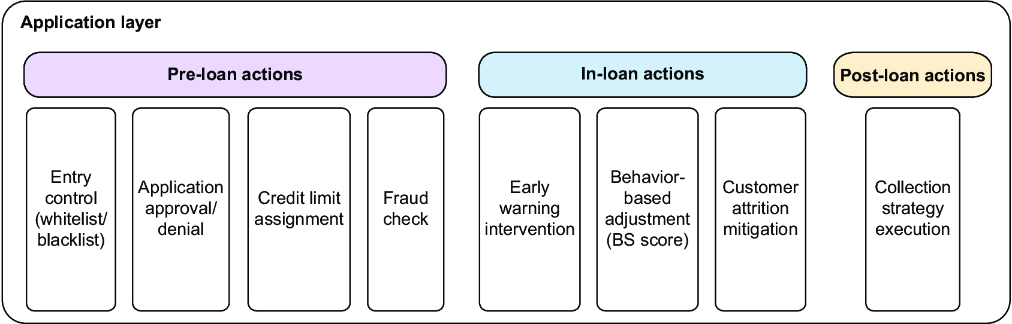
Across a credit lifecycle, the layer can coordinate:
- Before a loan: entry filters, fraud screening and credit limits informed by models and policy. section 4.3.4
- During a loan: early-warning interventions, offer expansions or conversations with customers at risk of leaving. section 4.3.4
- After a loan: collection cycles and communication through call centers, automated messages or legal notifications. section 4.3.4
Buy now, pay later checkout
Shopping-cart, user-profile and bureau data feed a default-risk model. Policy thresholds determine whether to approve or request more documentation, and the frontend promptly communicates the decision. Monthly monitoring helps teams adjust models and policies as consumer behavior changes. section 1.5.4
Fraud decisioning and investigation
For a payment, the layer works with model serving to score the transaction, then directs the payment gateway or banking system to approve, decline or challenge the user according to thresholds. For cases needing investigation, a case-management system gives analysts prioritized alerts, relevant data and a place to log actions for audit. section 7.4.5
Automation should fit the product’s risk and operational complexity: a checkout decision may be immediate, while a mortgage can combine automation with human review. In agent-based systems, the application layer can instead use an executor that observes, reasons, plans and acts; human approval remains part of governance for regulated decisions. section 4.3.4 section 14.1.2
Figure 1.7 In the application layer, loan officers, collection agents, and end customers interact with AI-driven outcomes via dashboards or real-time notifications. By bridging frontend systems (e.g., customer portals) and backend rule engines, actions such as approvals, limit changes, or fraud checks happen seamlessly. Because it’s closely tied to monitoring feedback loops, the application layer can adapt quickly to new data or policy shifts.
The diagram shows how customer portals and backend rule engines connect to decisions, notifications and monitoring feedback. section 1.5.4




