A side effect is an observable state or resource change caused by executing a method in addition to computing a return value. Sending an email is a side effect; retrieving data for a report is not. section 5.1
Use side effects to distinguish interactions that represent outcomes from interactions that merely supply input:
- Treat an interaction that produces an externally visible effect as an outgoing interaction and verify it with a mock. section 5.1
- Treat an interaction that supplies data for producing an outcome as an incoming interaction and emulate it with a stub. section 5.1
- Avoid verifying communications that cannot be observed externally; they are implementation details and make tests fragile. section 5.4
Email versus report creation
A greeting operation sends an email, so a test verifies SendGreetingsEmail once. Report creation retrieves a user count, so a test checks the resulting report rather than verifying the database call. section 5.1
Figure 5.2. Sending an email is an outcoming interaction: an interaction that results in a side effect in the SMTP server. A test double emulating such an interaction is a mock. Retrieving data from the database is an incoming interaction; it doesn’t result in a side effect. The corresponding test double is a stub.
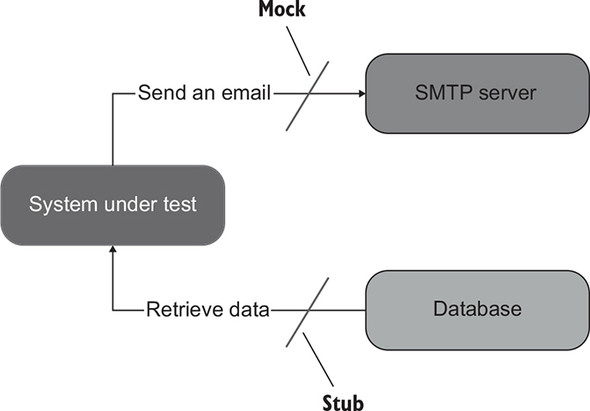
Compare an outgoing email interaction that causes an SMTP-server side effect with an incoming database interaction that only provides data. section 5.1























