A simulator reproduces relevant behavior of an online or real environment so algorithms can be tested offline. It becomes valuable when live experimentation is risky, expensive, or difficult to interpret. section 12.1.3
Use a simulator to:
- Test an algorithm against computationally generated environmental behavior before deployment. section 12.1.3
- Model time-series forecasting when historical labels, costs, and inventory turnover make outcomes relatively unambiguous. section 12.1.3
- Represent recommendation systems as agent–environment interactions, where context drives choices and feedback changes later behavior. section 12.1.3
Recommendation simulation
An advertising algorithm consumes a user's recent history, selects a banner, and seeks to maximize CTR, CVR, or eCPM. Because unshown items have no direct feedback, simulating alternative impressions is substantially harder than simulating labeled forecasts. section 12.1.3
Figure 12.1 Unbiased estimator (offline validation): stream of real events
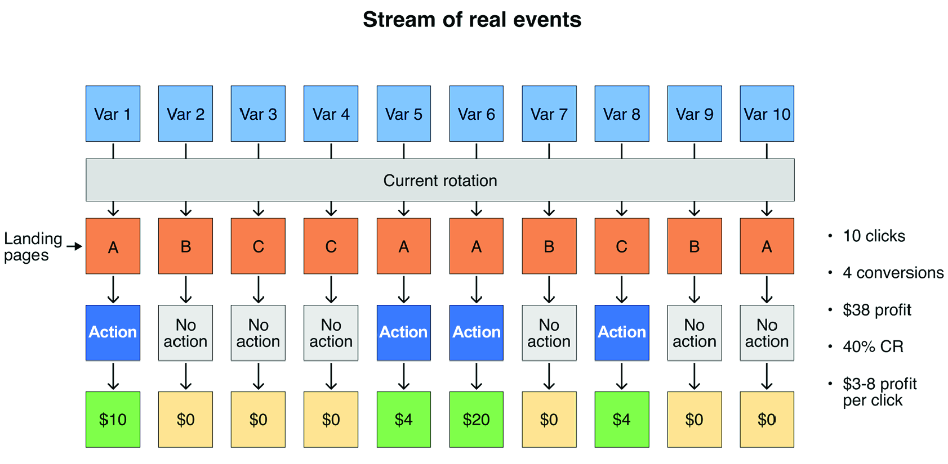
Compare the stream of real events with the event stream used for offline validation. section 12.1.3

