Single sign-on (SSO) lets a user authenticate once and access multiple applications without separately logging in to each one. An identity provider (IdP) handles authentication for those applications and issues proof of identity. section 12.4 section 12.5
Externalizing authentication avoids making every application store passwords and independently implement login security. It also lets multiple applications reuse centralized authentication logic and gives users a more consistent login experience. section 2.1 section 12.4
SSO can support several organizational and user-facing arrangements:
- Customer applications can offer username-and-password login, social login, biometric authentication, or password-based multifactor authentication through the SSO service. section 2.1.1
- Corporate SSO can connect employees to internal applications, customer-facing employee interfaces, and external SaaS applications using unified directory credentials. section 2.1.2
- Partner authentication can be delegated to a partner’s SSO service, allowing access to ACME systems to end when the partner revokes access. section 2.1.3
- Organizations can choose a managed SaaS service, a self-run commercial or open-source service, or a custom SSO service. section 2.1.1
OAuth2 and OpenID Connect (OIDC) provide standard ways for applications to delegate login to an SSO service. OIDC adds user identity information to OAuth2, while WebAuthn supports biometric login and phishing-resistant physical security keys. section 2.1.5 section 13.0
One login across a workday
An employee uses document, transaction, work-hours, and other applications throughout the day. Instead of authenticating separately to each application, the employee signs in through the corporate SSO service and reuses that authenticated session. section 12.0
Figure 2.3 An SSO service handles user account creation and authentication. Multiple applications can use the same SSO service, simplifying security for application developers. The SSO service supports authentication using OAuth2, OIDC, WebAuthn, and password-based multifactor authentication.
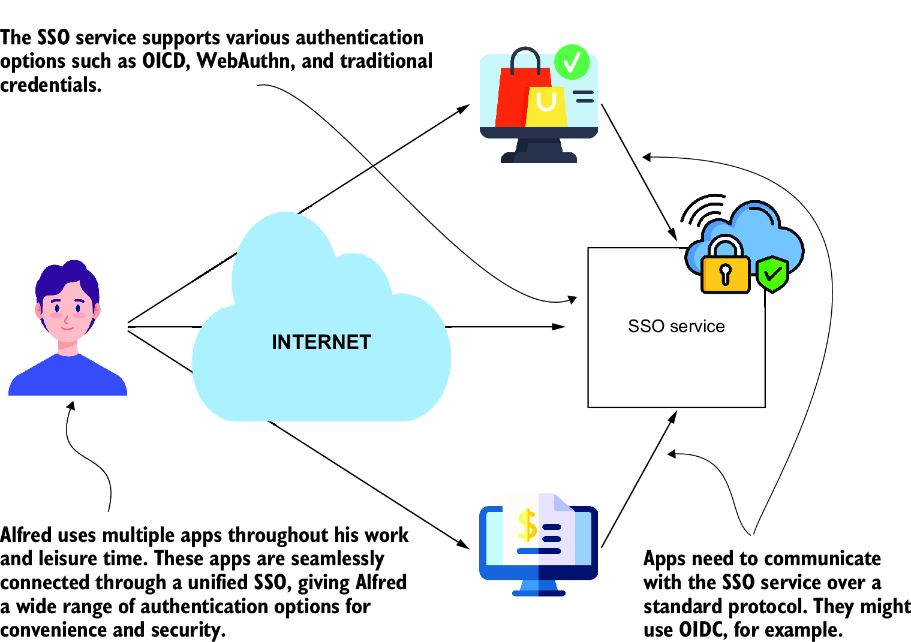
Shows how an SSO service handles account creation and authentication for multiple applications, including OAuth2, OIDC, WebAuthn, and password-based multifactor authentication. section 2.1.1


