Singular value decomposition (SVD) factors a large matrix into three smaller matrices—U, Σ, and V—to create a lower-dimensional approximation. The trade-off is practical: shrinking Σ reduces parameters and memory, but also reduces approximation accuracy. section 3.3.1
SVD becomes useful when compression or parameter-efficient adaptation matters:
- Compresses matrices or tensors by retaining a lower-dimensional representation rather than every original parameter. section 3.3.1
- Approximates a 100 × 100 weight update as Wa × Wb, using a rank c smaller than 100. section 5.3.5
- Trades memory savings against task complexity and accuracy: higher rank preserves more complexity, while lower rank saves more memory. section 5.3.5
A 4 × 4 low-rank approximation
Using SciPy and NumPy, decompose a 4 × 4 matrix with svds(matrix, k=1), then reconstruct it by multiplying u, s, and vt. The reconstruction uses 9 parameters instead of 16, but its values only approximate the original matrix. section 3.3.1
Figure 3.2 Example of SVD, a low-rank approximation. A is a large matrix with dimensions N and M. We can approximate it with three smaller matrices: U with dimensions M and P, Ʃ a square matrix with dimension P, and V with dimensions N and P (here we show the transpose). Usually, both P<<M and P<<N are true.
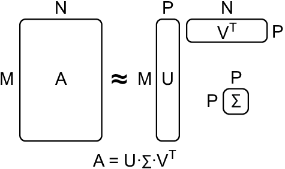
View the dimensional relationship between the original matrix A and its smaller U, Σ, and V factors. section 3.3.1





