A sinusoidal function describes a repeating waveform using sine or cosine. Its shape is determined by amplitude, frequency, and phase: amplitude sets peak height, frequency counts cycles over an interval, and phase shifts the wave horizontally. Sine and cosine have the same shape, offset by π/2 radians. section 7.1.1
Sampling a cosine signal
The general form A cos(2πft + φ) makes the parameters explicit. For eight samples, a normalized cosine can be generated with `samples = [1/sqrt(8) * cos(2 * pi * frequency * (t / 8)) for t in range(8)]` and plotted alongside a continuous curve to compare the discrete signal with its waveform. section 7.1.1
Composite sound waves can be decomposed into simpler sinusoids. A glass harmonica provides an intuitive example: glasses of different sizes vibrate at different frequencies, and the heard sound combines their components. section 7.1.1
In quantum-state representations, normalized complex sinusoids encode periodic patterns while satisfying the requirement that squared amplitude magnitudes sum to one. The real and imaginary components correspond to cosine and sine projections. section 7.1.2
Geometric sequence state
A reusable construction creates amplitudes with equal magnitude and phase advancing by θ: `geom(n, theta) = [sqrt(1/2**n) * cis(k*theta) for k in range(2**n)]`, where `cis(theta)` returns `cos(theta) + 1j*sin(theta)`. For three qubits and θ = π/3, the phase repeats because of sine and cosine periodicity. section 7.1.2
Figure 7.3 The sinusoidal wave sin(x) for real values x has amplitude 1, phase 0, and frequency 1.
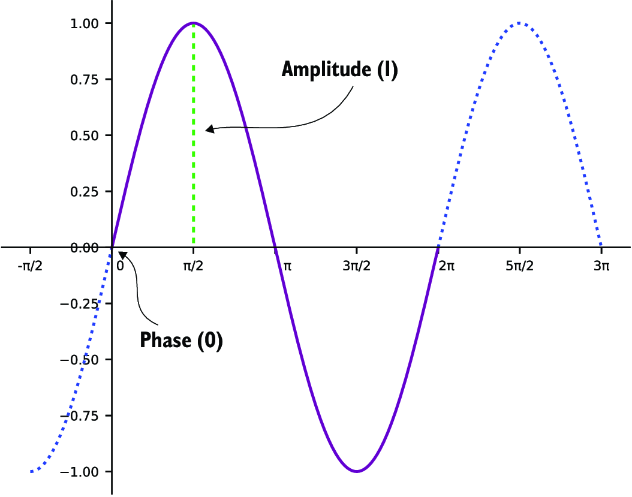
Use the waveform diagram to inspect amplitude, zero phase, and frequency one for sin(x). section 7.1.1
Figure 7.6 Projections of the sine and cosine parts of a complex sinusoid
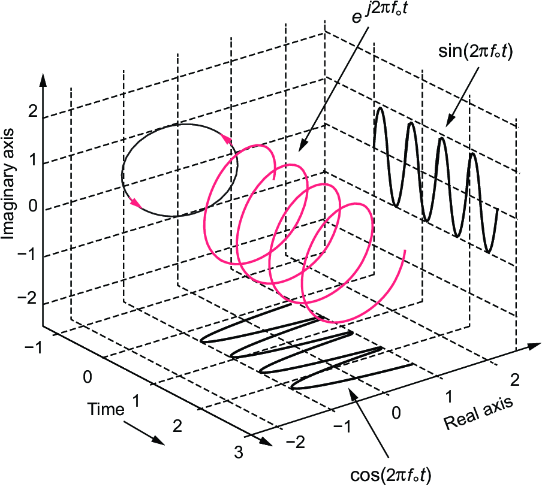
Use the projection diagram to see how a complex sinusoid combines cosine and sine components. section 7.1.2

