A sound wave is a periodic signal: a repeating pattern that travels through air and can be perceived as sound. Musical notes provide a familiar example of repetition over time. section 7.1
Describe a sound wave through these related properties and compositions:
- Frequency counts the cycles completed during a given time interval. section 7.1.1
- Amplitude measures peak height, while phase describes a horizontal shift of the wave. section 7.1.1
- Composite sound waves combine multiple individual waves and can be decomposed into simpler sinusoidal waves. section 7.1.1
A glass harmonica
A glass produces sound when tapped or rubbed around its rim. Its size and shape determine its resonant frequency: larger glasses generally produce lower frequencies, while smaller glasses produce higher ones. Combining several glasses creates a composite sound containing their frequencies. section 7.1.1
Discrete signal samples
A sampled cosine wave can be represented by eight discrete values using a frequency parameter and normalized amplitude, then plotted alongside a denser curve to visualize the underlying signal. section 7.1.1
A glass harmonica and the composition of waves
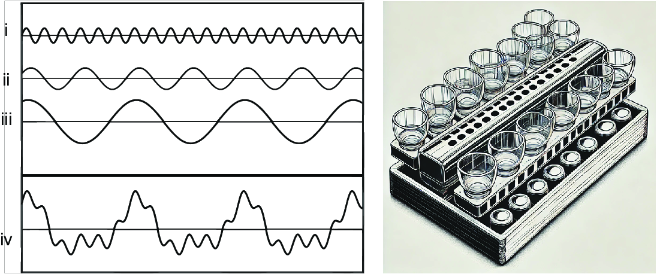
Use the glass-harmonica figure to visualize how separate vibrating glasses contribute frequencies to one perceived sound. section 7.1.1
