Situation awareness is the operational understanding of an organization’s business, technology environment, processes, security controls, data, and internal and external threats. It supports informed security decisions and makes threat hunts relevant, structured, and effective. section 2.4 section 2.1
Build situation awareness by mapping:
- Business markets, products, services, and the technology services delivered to users. section 2.4
- Systems, applications, operating systems, software, deployment locations, and cloud service models. section 2.4
- Prevention, detection, and response controls, plus the data they generate, where it is stored, and how it is accessed. section 2.4
- Threat actors, tactics and techniques, and previous or current security incidents. section 2.4
Apply this knowledge when creating a threat-hunting hypothesis. Relevance depends on understanding both the threat and its current deployment in the environment; testability depends on available systems, events, data, and tools. Awareness improves as hunts, threat intelligence, applications, and systems provide new information. section 2.2.3
Undetected activity across a network
A red team finds malicious techniques running undetected on Windows 10 machines without antivirus or SOC alerts. The hunter maps user endpoints, an internet gateway, a site-to-site VPN, and cloud-hosted servers, then researches the threat, formalizes a hunt, and searches for similar activity. section 3.1.1
Figure 3.1 High-level network diagram
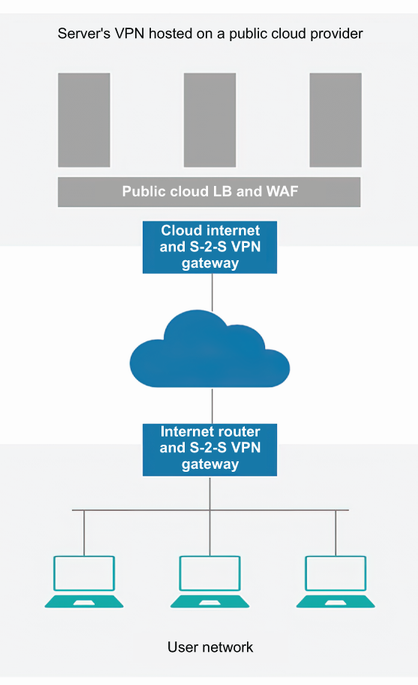
Use the network diagram to relate endpoints, internet connectivity, VPN access, and cloud-hosted servers before defining hunt scope. section 3.1.1
