Smoothness means that similar inputs are correlated, so nearby points tend to produce similar function values. In a Gaussian process (GP), conditioning on an observation updates predictions around that observation rather than at one isolated point. section 2.3
The covariance function, also called the kernel, sets this relationship and therefore controls the GP’s smoothness. A large length scale produces smoother predictions and less uncertainty; different dimensions can use different length scales. section 3.4 section 3.6
A nearby observation
After observing a high function value at 3, a smooth GP raises its predictions at 2.9 and 3.1 because those inputs are close to 3. The same behavior appears when conditioning on several observations: the posterior mean smoothly interpolates the data while uncertainty decreases around observed points. section 2.3
Use covariance choices to express different assumptions about smoothness:
- Increase the length scale to model slower output variation and smoother predictions. section 3.6
- Use automatic relevance determination when different input dimensions vary at different rates. section 3.6
- Use the Matérn kernel’s parameter nu to represent different levels of prediction smoothness. section 3.6
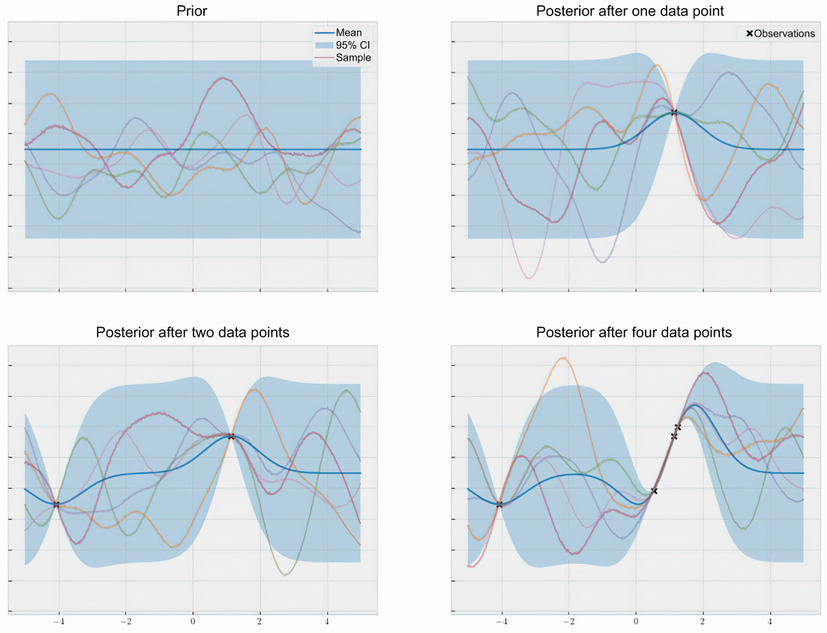
Compare GP predictions after conditioning on zero, one, two, and four observations to see smooth interpolation and local uncertainty reduction. section 2.3

