Smoothness measures how completely a function or curve avoids abrupt changes. A function is continuous when adjoining pieces meet at the same value; it is smooth when their derivatives meet as well. section 5.2.1 section 5.6
The order of continuity records how many derivatives remain continuous:
- C0 means the function is continuous, although its derivative may not be. section 5.2.1
- C1 means the function and its first derivative are continuous, eliminating sharp corners in its graph. section 5.2.1
- C2 also preserves second-derivative continuity and is associated with matching curvature. section 5.6
- Cn means every derivative through the nth remains continuous; higher-order smoothness implies lower-order smoothness. section 5.2.1 section 5.5
Two piecewise joins
The pieces x² + 1 for x < 0 and 1 − x² for x ≥ 0 meet at value 1 and derivative 0, so their join is C1. The pieces x − 0.5 for x < 1 and 1.5 − x for x ≥ 1 meet continuously but have unequal derivatives, producing a corner rather than a smooth join. section 5.2.1
Smoothness makes piecewise and parametric curves practical for engineering. Cubic pieces can match endpoint positions and tangent values, but tangent magnitudes must be controlled: exaggerated gradients can create unwanted loops even when the contour remains technically smooth and continuous. section 5.6 section 12.4.4
Figure 12.23 By normalizing tangent vectors, we keep the contour smooth, but the unwanted loops are gone.
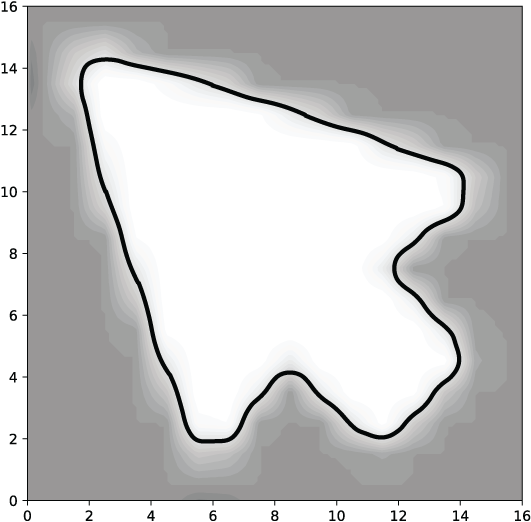
Compare the normalized-tangent contour with the looped result caused by exaggerated tangent vectors. section 12.4.4

