SNMPv1 provides basic network monitoring and management between a network management system (NMS) and managed devices. It uses community strings as passwords, without encryption, and supports Get, GetNext, Set, Trap, and Response messages. section 6.3
Use the community type to control what an NMS can do:
- RO permits Get and GetNext requests, allowing the NMS to read information but rejecting Set requests. section 6.3.1
- RW permits both reading with Get and writing with Set. section 6.3.1
- SNMPv1 has no GetBulk or Inform messages; those were added by SNMPv2c and SNMPv3. section 6.3
Basic Cisco IOS configuration
R1(config)# snmp-server community password123 RO R1(config)# snmp-server community password456 RW These commands configure separate read-only and read-write community strings. Add `snmp-server enable traps` to enable traps, then specify the NMS with `snmp-server host 192.168.1.10 version 2c password789`. An ACL can restrict which NMS sources may use a community. section 6.3.1
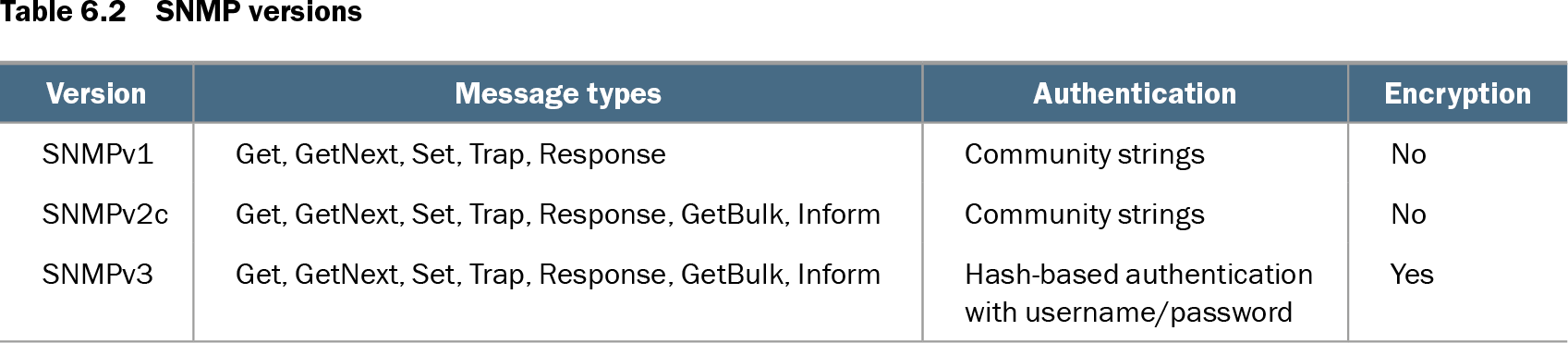
Table 6.2 SNMP versions (view table figure)
| Version |
Message types |
Authentication |
Encryption |
|---|---|---|---|
| SNMPv1 |
Get, GetNext, Set, Trap, Response |
Community strings |
No |
| SNMPv2c |
Get, GetNext, Set, Trap, Response, GetBulk, Inform |
Community strings |
No |
| SNMPv3 |
Get, GetNext, Set, Trap, Response, GetBulk, Inform |
Hash-based authentication with username/password |
Yes |
Compare SNMPv1 with SNMPv2c and SNMPv3 by message types, authentication, and encryption. section 6.3