Software as a service (SaaS) delivers a complete, provider-hosted application on a “pay and play” basis. The provider manages nearly everything behind the software, so users focus on using it rather than maintaining servers, operating systems, or patches. section 1.1
SaaS shifts responsibility upward compared with other cloud service models:
- Compared with infrastructure as a service, SaaS hides hardware, virtualization, networking, storage, and virtual machines. section 1.1
- Compared with platform as a service, SaaS also hides the operating system, maintenance tasks, updates, patches, and runtime concerns. section 1.1
- Users still manage application identities, including users, while responsibility for client devices and endpoints remains shared. section 6.2.4
A pay-and-play application
A SaaS user accesses software hosted in the cloud without owning or maintaining the underlying equipment. The arrangement removes infrastructure work, but users must still manage who can access the application and consider endpoint security. section 1.1 section 6.2.4
Figure 1.2 Cloud computing abstraction layers. The responsibility shifts between you and the cloud provider across IaaS, PaaS, and SaaS. As you move up the layers, the provider manages more—from physical infrastructure and virtualization in IaaS, to the OS and runtime in PaaS, and nearly everything in SaaS—leaving you to focus on just your applications and data.
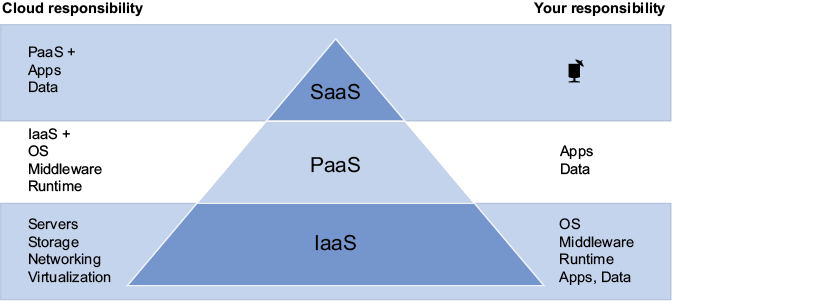
Use the abstraction-layer diagram to compare how responsibility moves from the customer toward the provider across IaaS, PaaS, and SaaS. section 1.1

