liveBook · Manning

Solicited-node multicast address

As explained in Acing the CCNA Exam: Volume 1 Fundamentals and Protocols

A solicited-node multicast address is an IPv6 multicast address derived from the last six hexadecimal digits of a unicast address for targeting specific neighbors on a link.

A solicited-node multicast address is an IPv6 multicast address derived from a unicast address. It lets NDP target likely neighbors without IPv4-style broadcast. Its ff02 prefix gives it link-local scope, so routers do not forward it. section 21.1.1 section 20.5.4

Generate the address by following these steps:

  • Take the last six hexadecimal digits of the unicast address. section 21.1.1
  • Prepend ff02::1:ff to those six digits. section 21.1.1
  • Use the resulting group for NDP messages such as Neighbor Solicitation; the target replies with a unicast Neighbor Advertisement. section 21.1.2

Address calculation and overlap

The unicast address 2001:db8::12:3456 produces ff02::1:ff12:3456. Different unicast addresses can produce the same solicited-node group, so an NS message’s Target Address identifies the intended host. section 21.1.2 section 21.4

Figure 21.1 How to generate a solicited-node multicast address. Prepend ff02:0000:0000:0000:0000:0001:ff (abbreviated to ff02::1:ff) to the last six hexadecimal digits of the unicast address.
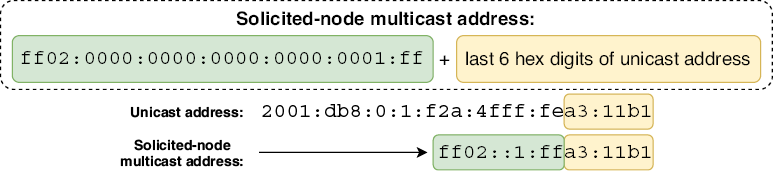
Use the generation diagram to visualize the fixed prefix and six-digit suffix. section 21.1.1

How Acing the CCNA Exam: Volume 1 Fundamentals and Protocols covers it

How deep it goes
Explains construction, link-local scope, NDP exchange, overlapping groups, and Cisco inspection output while deferring multicast MAC details.
Examples
Uses calculated address pairs, overlapping host addresses, and show ipv6 interface output displaying joined solicited-node groups.
What you can do after
Diagnose NDP targeting by calculating the expected group and checking joined multicast groups with show ipv6 interface.
How it connects
Connects IPv6 multicast with Neighbor Discovery Protocol, Neighbor Solicitation, Neighbor Advertisement, and duplicate address detection.

Related concepts

This explainer was generated by Manning's knowledge graph from the text of Acing the CCNA Exam: Volume 1 Fundamentals and Protocols. The section links point to the parts of the book it draws on.