A Neighbor Solicitation (NS) message is an ICMPv6 type 135 message used by Neighbor Discovery Protocol (NDP) to resolve a neighbor’s IPv6 address to its MAC address. It performs an IPv6 role similar to an IPv4 ARP request. section 21.1.2
Because IPv6 has no broadcast address, the sender sends the NS message to the target’s solicited-node multicast address. The neighbor replies with a unicast Neighbor Advertisement (NA) containing its MAC address. section 21.1.2 section 21.4
An NS exchange matters operationally because it:
- Creates an IPv6 neighbor-table mapping between a Layer 3 address and a Layer 2 address. section 21.4
- Uses multicast rather than an IPv4-style broadcast request. section 21.1.2
- Can reveal a forwarding failure when an entry remains INCMP (incomplete) because no MAC address was learned. section 21.3.1
Address resolution and verification
After R1 pings R2 at 2001:db8::2, show ipv6 neighbors displays R2’s IPv6 address, MAC address, REACH state, and interface. This confirms that NDP resolved the neighbor.
Figure 21.2 An NDP exchange between two routers. R1 sends an NS message to learn R2 G0/0’s MAC address, and R2 sends an NA message in response.
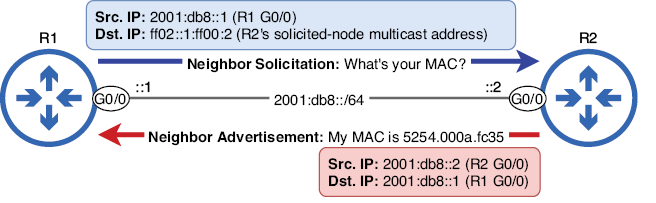
Use the exchange diagram to visualize R1 sending an NS and R2 returning an NA. section 21.1.2
