liveBook · Manning

Sparsity

As explained in Introduction to Generative AI, Second Edition

Sparsity is the property of a model or representation in which relatively few parameters or components are active or nonzero for a computation.

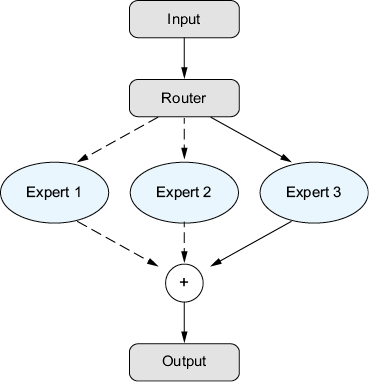
Sparsity means that relatively few model parameters contribute to a computation while many remain inactive. In sparse mixture-of-experts (MoE) models, a router selects only a few expert models for each output. section 2.17 section 2.6

Sparsity can improve efficiency, but it introduces trade-offs:

  • Using fewer experts can significantly reduce inference costs and typically increase inference speed. section 2.6
  • Fewer active parameters can reduce overfitting by producing a less complex prediction function. section 2.6
  • Inactive parameters still occupy memory, and expert balance, data allocation, and loss-function choices affect performance. section 2.6
Figure 2.6 A visualization of the Mixture of Experts layer of a neural network
A diagram of a expert

AI-generated content may be incorrect.

Visualizes an MoE layer in which a router selects one or a few experts, making inactive parameters visible. section 2.6


How Introduction to Generative AI, Second Edition covers it

How deep it goes
Defines sparsity, explains router-selected experts and benefits, then stops short of detailed implementation.
Examples
Illustrates sparsity with a three-expert MoE layer where only expert 3 contributes to the output.
What you can do after
Understand how sparse routing can reduce inference costs while retaining inactive parameters in memory.
How it connects
Connects sparsity with Mixture of Experts, gating networks, inference, overfitting, and loss functions.

Also explained in

Compare how 4 books explain sparsity →

Related concepts

This explainer was generated by Manning's knowledge graph from the text of Introduction to Generative AI, Second Edition. The section links point to the parts of the book it draws on.

