Split
Split is an operation or function that divides a string or sequence into parts according to a separator, pattern, or other rule.
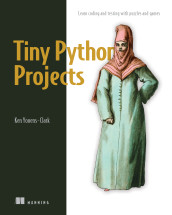
Tiny Python Projects: Learn coding and testing with puzzles and games
str.split() is a Python string method that divides a string into a list of substrings using a separator or, by default, whitespace.
- How it is used
- Applies string splitting to count tokens, build word lists, parse simple delimited records, and prepare text for transformations.
- How deep it goes
- Explains default whitespace and explicit separators through runnable examples, but defers robust word tokenization and full CSV handling.
- Examples
- Demonstrates word counting, multiline adjective lists, insult generation, text tokenization, gematria encoding, and manual CSV records.
- What you can do after
- Apply it via Python string methods to turn whitespace- or delimiter-separated text into lists for counting, validation, and further processing.
Read how Tiny Python Projects: Learn coding and testing with puzzles and games explains split →

The Quick Python Book, Fourth Edition
split is a string method that divides a string into a list of substrings according to a separator or, by default, whitespace.
- How it is used
- Uses split to parse delimited records and divide unstructured text into words or paragraphs.
- How deep it goes
- Explains default whitespace, explicit separators, and split limits with examples, including the omission of separators from results.
- Examples
- Demonstrates splitting pipe-delimited temperature records, extracting paragraphs, and counting words in a file.
- What you can do after
- Apply it in Python to extract fields or words while accounting for split limits and omitted separators.
Read how The Quick Python Book, Fourth Edition explains split →
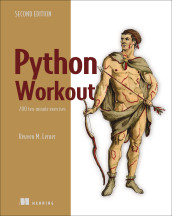
Python Workout, Second Edition
str.split is the Python string method that divides a string into a list of substrings using a specified separator or, by default, runs of whitespace.
- How it is used
- Turns sentences, file lines, and user input into fields for later processing.
- How deep it goes
- Explains separators, whitespace defaults, maxsplit, returned lists, and failure cases; stops short of implementing multiple separators without re.split.
- Examples
- Uses Pig Latin sentences, colon-delimited passwd records, calculator expressions, file word counts, and whitespace-separated integers.
- What you can do after
- Apply it via Python's str.split to tokenize text, unpack fields, cap splits, and feed results into later transformations.

Python Workout: 50 ten-minute exercises
str.split is a Python string method that divides a string into a list of substrings using a specified separator or runs of whitespace by default.
- How it is used
- Deploys string splitting to transform sentences, parse file records, count words, and process whitespace-separated input.
- How deep it goes
- Explains separators, repeated whitespace, list results, immutable-string trade-offs, and the need for re.split with multiple delimiters.
- Examples
- Uses Pig Latin sentences, colon-separated password records, Apache logs, text files, and whitespace-separated integers.
- What you can do after
- Apply str.split with explicit or default delimiters, then combine, filter, convert, count, or transform the resulting substrings.
Read how Python Workout: 50 ten-minute exercises explains split →

Python How-To
Split is a regular-expression method that divides a string at occurrences of matched patterns, optionally limiting the number of divisions.
- How it is used
- Processes strings by dividing them at regular-expression matches.
- How deep it goes
- Defines pattern-based splitting, optional maximum splits, and contrasts it with literal splitting and rsplit.
- Examples
- Uses digit-pattern splitting, comma-separated task records, and comparisons between split and rsplit.
- What you can do after
- Apply it via Python regular-expression calls to separate text at flexible patterns and optionally cap the divisions.

Deep Learning with R, Third Edition
Splitting is the segmentation of text into a sequence of individual tokens.
- How it is used
- Prepares written text for numeric representation by dividing it into tokens before indexing and modeling.
- How deep it goes
- Explains character and word splitting with runnable R functions, punctuation handling, regex context, and vocabulary indexing, but defers regex instruction.
- Examples
- Uses the sentence "The quick brown fox jumped over the lazy dog." to demonstrate character tokens, word tokens, punctuation, and vocabulary IDs.
- What you can do after
- Apply splitting via stringr boundary functions to produce character or word tokens for later vocabulary indexing.
Read how Deep Learning with R, Third Edition explains split →

Get Programming: Learn to code with Python
split is a Python string method that divides a string at occurrences of a separator and returns the resulting parts as a list.
- How it is used
- Converts delimited strings into lists for easier analysis and later list operations.
- How deep it goes
- Demonstrates one-line conversion, explains the resulting list, and applies splitting after text cleanup.
- Examples
- Uses comma-separated emails and cities, cleaned document text, and short separator-focused practice questions.
- What you can do after
- Apply it by converting comma- or space-delimited strings into lists for sorting and word processing.
Read how Get Programming: Learn to code with Python explains split →
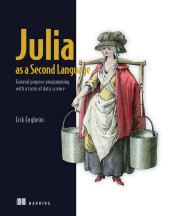
Julia as a Second Language
split is a Julia function that divides a string into substrings based on a delimiter, character predicate, or whitespace.
- How it is used
- Separates text fields for data processing and tests predicate-based splitting in a case-conversion task.
- How deep it goes
- Explains delimiter and predicate splitting through examples, including discarded matching characters, without exploring substring internals.
- Examples
- Uses pizza sales records, a rocket-engine CSV file, and a camel-case string.
- What you can do after
- Apply it via Julia’s split function to extract fields or split on a character predicate.
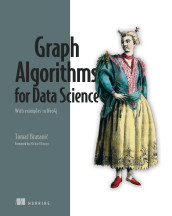
Graph Algorithms for Data Science
A split function divides a string around a delimiter and returns the resulting elements as a list.
- How it is used
- Extracts hashtag tokens from tweet text as part of a Cypher-based graph data preparation workflow.
- How deep it goes
- Defines the function and demonstrates its place in a cleaning, filtering, normalization, and list-processing pipeline.
- Examples
- Uses newline-cleaned tweets split on spaces to produce normalized hashtag lists.
- What you can do after
- Apply via Cypher to convert delimited strings into lists for filtering, transforming, or storing extracted elements.
Learn AI-Assisted Python Programming, Second Edition
The string split method divides text around a separator and returns the resulting parts as a list.
- How it is used
- Separates columns from lines read in a comma-separated statistics file.
- How deep it goes
- Defines the separator call and list result, then demonstrates indexing and repeated processing without discussing implementation internals.
- Examples
- Uses NFL offensive statistics, comma-separated headers, player names, positions, and passing-yard columns.
- What you can do after
- Apply it via Python to extract fields from delimited lines and process those fields in file-reading programs.
Read how Learn AI-Assisted Python Programming, Second Edition explains split →
100 Java Mistakes and How to Avoid Them
- How it is used
- Diagnoses delimiter mistakes when splitting Java strings with regex-aware APIs.
- How deep it goes
- Explains regex interpretation, Java escaping, limit semantics, and literal-splitting alternatives.
- Examples
- Uses java.util.concurrent, a comma-separated string with trailing commas, and literal-dot splitting.
- What you can do after
- Apply Java String.split() safely with escaped or quoted delimiters and deliberate limit values.
Read how 100 Java Mistakes and How to Avoid Them explains split →
Also covered in
- Pandas Workout: 200 exercises to make you a stronger data analyst
- Learn Go with Pocket-Sized Projects
- Learn PowerShell in a Month of Lunches: Fourth Edition, Covers Windows, Linux, and macOS
- Learn Haskell by Example
- Generative AI in Action
- Clojure: The Essential Reference
- Kotlin in Action, 2E
- The Well-Grounded Rubyist, Fourth Edition
- Natural Language Processing in Action, Second Edition
- Grokking Machine Learning, Second EditionIn early access (MEAP)
What to know first
- stringA string is a programming-language value representing textual data as an ordered sequence of characters or encoded units.
- listA list is an ordered collection of elements arranged in a sequence.
- regular expressionA regular expression is a formal pattern notation that describes sets of strings and specifies how text can be matched, searched, or transformed.
- plain textPlain text is character data represented without rich formatting, styling, or presentation instructions.
Related concepts
- listproduces · A list is an ordered collection of elements arranged in a sequence.
- regular expressionuses · A regular expression is a formal pattern notation that describes sets of strings and specifies how text can be matched, searched, or transformed.
- file pathalternative to · A file path is a textual or structured identifier specifying the location of a file or directory in a filesystem.
- tokenizationpart of · Tokenization is the process of dividing text into discrete units called tokens for computational processing.
- stringuses · A string is a programming-language value representing textual data as an ordered sequence of characters or encoded units.
Questions about split
What is split?
Split is an operation or function that divides a string or sequence into parts according to a separator, pattern, or other rule.
Which Manning books explain split?
Tiny Python Projects: Learn coding and testing with puzzles and games, The Quick Python Book, Fourth Edition, Python Workout, Second Edition, Python Workout: 50 ten-minute exercises, Python How-To, Deep Learning with R, Third Edition, Get Programming: Learn to code with Python, Julia as a Second Language and 3 more.
What should I know before learning split?
Manning books that teach split usually introduce string, list, regular expression and plain text first.
What is the difference between split and file path?
Split is an operation or function that divides a string or sequence into parts according to a separator, pattern, or other rule. A file path is a textual or structured identifier specifying the location of a file or directory in a filesystem.
What is split part of?
Split is part of tokenization. Tokenization is the process of dividing text into discrete units called tokens for computational processing.
What is split also called?
Split is also called Splitting.
These guides are generated from the text of Manning books by Manning's knowledge graph and link to the sections they draw on. The full books are available on liveBook and at manning.com.