Split-complementary colors form a three-color scheme by pairing one hue with the two hues beside its direct complement on the color wheel. For example, purple pairs with yellow and orange. section 9.2.1
Use the relationship as a practical palette rather than letting three strong colors compete:
- Assign roughly 60% of the design to the primary color, 30% to the secondary color, and 10% to a small accent. section 9.2.1
- Adjust saturation and lightness to create shades, tints, or more neutral variations instead of relying on intense, pure hues. section 9.2.1
- Check text contrast and pair color with icons or labels so color is not the only carrier of information. section 9.9
A purple-led palette
Start with purple as the dominant hue, use yellow as the supporting color, and reserve orange for a small accent. A softer variation can use yellow-orange, yellow-green, and purple shades or tints. section 9.2.1
Figure 9.14 An example of a split complementary color scheme using shades and tints of yellow-orange, yellow-green, and purple.
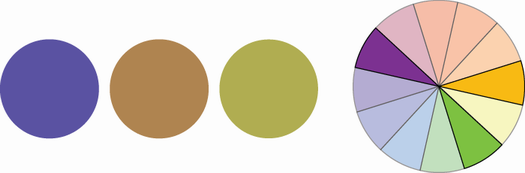
Browse the split-complementary palette showing yellow-orange, yellow-green, and purple through shades and tints. section 9.2.1