A staging environment is an isolated pre-production checkpoint meant to mirror production before software reaches users. The traditional version is a permanent, physical replica. It can catch problems that local checks cannot, but a replica is not a guarantee: as systems grow, data states and environment sizes drift, and simulated traffic may not match real demand. section 13.7
Choose whether to keep a traditional staging tier by weighing isolation needs against the cost and limits of simulation:
- Keep staging when regulations require a physical boundary between unreleased code and user records, or when shared databases and legacy systems cannot be safely isolated with code-level controls. section 13.7.1
- Consider promoting without a permanent tier only when automated CI/CD tests are comprehensive and deterministic, services are decoupled, temporary preview environments are available, and production traffic can be controlled with tools such as feature flags or canary proxies. section 13.7.1
Figure 13.11 The Staging Dilemma: Traditional staging often promises perfect parity, but in reality, it frequently drifts from production, offering a false sense of security.
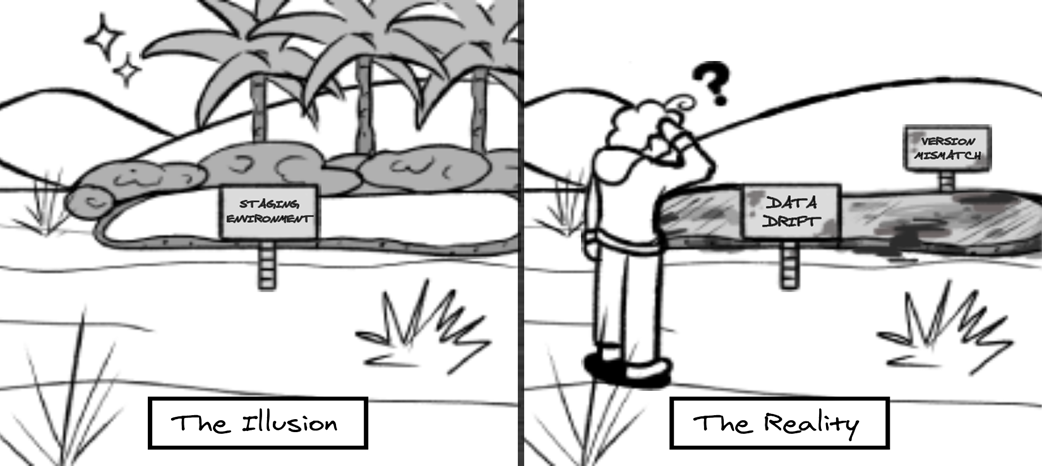
The staging dilemma: a replica may promise production parity while drifting from production and creating false confidence. section 13.7