A finite-state machine models clinical workflow as defined states connected by valid transitions triggered by events, conditions, or completed actions. In an EHR, it turns an order into an active, auditable process rather than a passive database record. section 2.0 section 2.2.3
A CBC order can move through a controlled lifecycle:
- Null: the order does not exist. section 2.2.3
- Draft: a clinician selects the test but has not signed it. section 2.2.3
- Active: the signed order passes EHR validation. section 2.2.3
- Transmitted: the order reaches clinical units and the laboratory information system. section 2.2.3
- In Process: the specimen is collected, sent, and received by the laboratory. section 2.2.3
- Completed: laboratory results are finalized and entered into the EHR. section 2.2.3
Each transition records the responsible actor, location, and time. Enforcing the sequence prevents skipped steps, preserves an audit trail, and produces structured data that supports safety, compliance, and real-time workflow monitoring. section 2.2.4 section 2.4
Concurrent clinical states
A patient may simultaneously be in surgery, awaiting laboratory results, and progressing through discharge. Separate state machines coordinate these workflows: when a laboratory result changes to Completed, the EHR can update a surgical checklist and notify the responsible clinician. section 2.2.4
Figure 2.5 The divergence between complex clinical reality and structured system data.
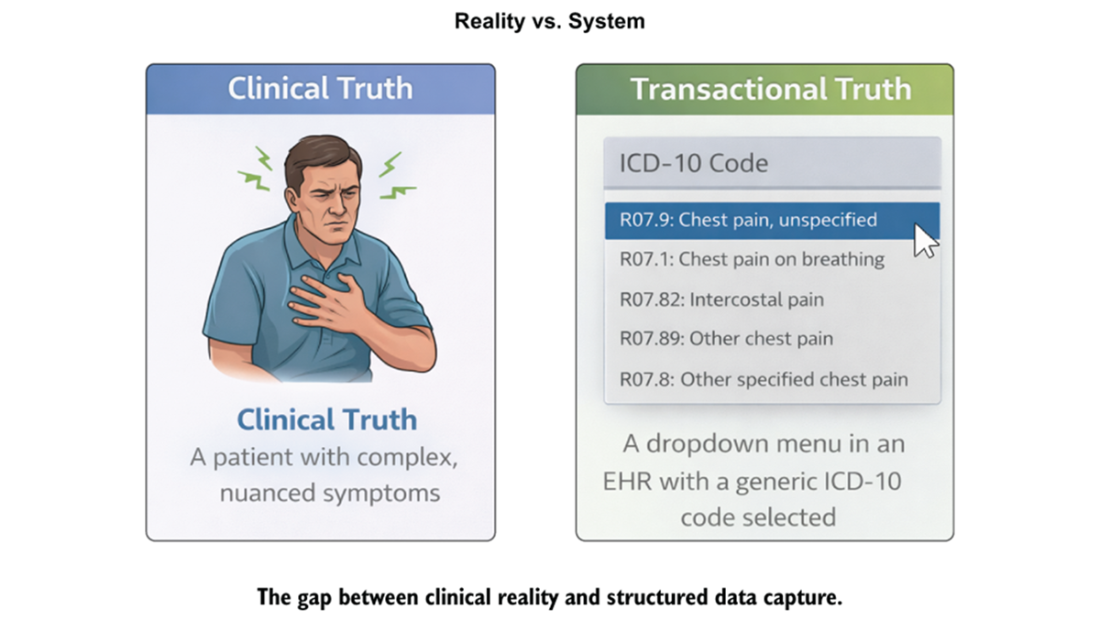
Compare the patient’s complex clinical reality with the structured transactional data captured by workflow states and events. section 2.2.3