A state-space model describes a system whose true state is hidden but changes over time. It separates the evolving latent state from the observations generated by that state. section 9.2
This separation fits time series such as atmospheric CO₂: the underlying concentration evolves gradually, while measurements include noise. The transition model connects future states to current states; the observation model connects states to measured data. section 9.2
Sequential inference follows a repeating cycle:
- Specify how the latent state evolves with a state transition model. section 9.3
- Predict the next state using the current filtered belief and transition model. section 9.3
- Update that prediction when a new observation arrives through the observation model. section 9.3
- Repeat the predict-and-update cycle to track beliefs, uncertainty, and forecasts over time. section 9.0
Atmospheric CO₂
Treat the true CO₂ concentration in each year as the hidden state and the recorded concentration as a noisy observation. A filter predicts the next year's concentration, then corrects it using the new measurement. section 9.2 section 9.3
Figure 9.3 A diagram of a state space model, which includes an unknown latent space 𝑥ᵢ that evolves over time, and the observation model, which describes the relationship between the latent state and observed data 𝑦ᵢ at each time step.
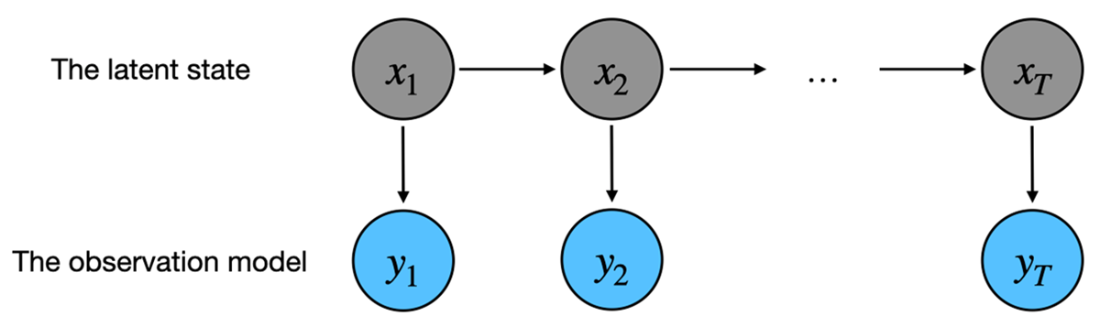
Use the diagram to distinguish the hidden state sequence from the observed data sequence and their relationship at each time step. section 9.2
