A stream-aligned team organizes around a continuous flow of work for a specific business or customer value stream. It owns that domain end to end, delivering and maintaining its capabilities through an API or UI that end users can manage in an effective, expected format. section 3.1.1
Effective domain boundaries reduce intrateam communication needed merely to stay productive. Teams should access other teams’ capabilities through APIs or solve common needs independently using well-documented standards. section 3.1.1
A stream-aligned team typically:
- Aligns its work with a specific business domain or customer value stream. section 3.1.1
- Owns services from development through production and responds directly to customer needs and market changes. section 10.3.2
- Uses autonomy to make decisions and move quickly within its domain. section 10.3.2
- Consumes internal platform capabilities, while the platform team treats stream-aligned teams as its customers. section 3.1.1 section 10.3.2
Epetech’s domain teams
Epetech created an e-commerce team for the shopping platform, including the interface, cart, and checkout; a mobile app team; and an inventory management team for stock, logistics, and supply-chain integrations. Each team owned its services from development to production. section 10.3.2
Figure 3.1 The stream-aligned teams are domain-bounded, but so are the platform team and subsystem team. (Image taken from [1]. Used with permission.)
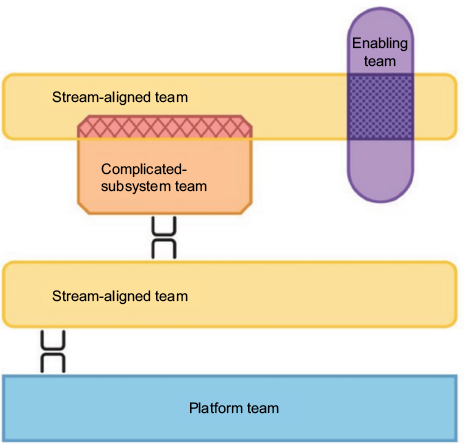
Use the topology diagram to compare domain boundaries across stream-aligned, platform, and complicated subsystem teams. section 3.1.1

