A stream processing instance (SPI) is an Atlas namespace for one or more continuously running stream processors. It is tied to a connection string, cloud provider, region, and optional security context. Processors created in one instance remain available only within that instance. section 15.4.1 section 15.9
Figure 15.4 A stream processing instance is composed of multiple stream processors, such as aggregation-1 and aggregation-2, each dedicated to a specific task within the stream processing environment. These processors reside within the stream instance and are closely tied to the Connection Registry, which serves as a key store for managing secure connections to external resources. The bidirectional arrow between the Connection Registry and the stream instance signifies a dynamic interaction in which the stream instance relies on the registry for credentials or configuration settings to execute processing tasks effectively. (Image © MongoDB 2024 CC BY-NC-SA 3.0)
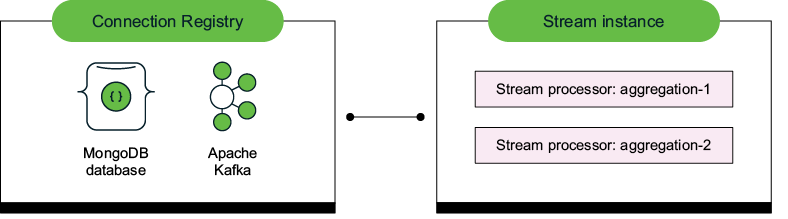
Shows how multiple stream processors reside inside an instance and use the Connection Registry for credentials and external-service configuration. section 15.4.1
The Connection Registry stores endpoints, authentication credentials, and other settings for external sources and sinks. Registry connections belong exclusively to their instance, can serve multiple processors, and can act as either a source or a sink. section 15.4.1 section 15.9
Create and connect to an SPI with the Atlas CLI and mongosh:
- Create an instance in AWS Frankfurt with `atlas streams instances create MongoDB-in-Action-SPI --provider "AWS" --region FRANKFURT_DEU`. section 15.6.2
- List instances with `atlas streams instances list`, then inspect the new instance with `atlas streams instances describe MongoDB-in-Action-SPI`. section 15.6.2
- Copy the SPI connection string from Atlas, connect with mongosh, and run `sp.listConnections()` to inspect the current registry. section 15.6.2
Capacity scales with processor activity: workers are allocated as processors launch, new processors prefer available workers, and workers can be deprovisioned after all processors on them stop. Project-level management is available through the Project Stream Processing Owner role, while audit logs remain for the SPI lifetime and 30 additional days after deletion. section 15.4.1 section 15.8.1 section 15.8.4
