Structured extraction turns unstructured text into usable facts, entities, and relationships. It supports factual question answering, knowledge-graph construction, and checks on generated language-model output. section 1.10 section 11.1
A practical extraction pipeline combines complementary techniques:
- Use regular expressions and manually defined patterns when compact condition checks can reliably capture key information or enforce logical actions. section 11.1.1
- Identify named entities, resolve references such as pronouns, and extract relations connecting entities in a sentence. section 11.3
- Apply part-of-speech tagging and dependency parsing to expose relationships between entities. section 11.11
- Store extracted relationships in a knowledge graph so systems can retrieve facts and ground their reasoning. section 11.1 section 11.11
From a reminder request to graph facts
A reminder command requires more than recognizing words: extraction must connect the person entity to the command, infer the chatbot as the implied subject, and interpret “next Monday” as a future date. A separate workflow tests extraction on a cached Wikipedia article about Timnit Gebru, providing realistic text for identifying entities and relations. section 11.3
Figure 11.2 Four stages of knowledge extraction
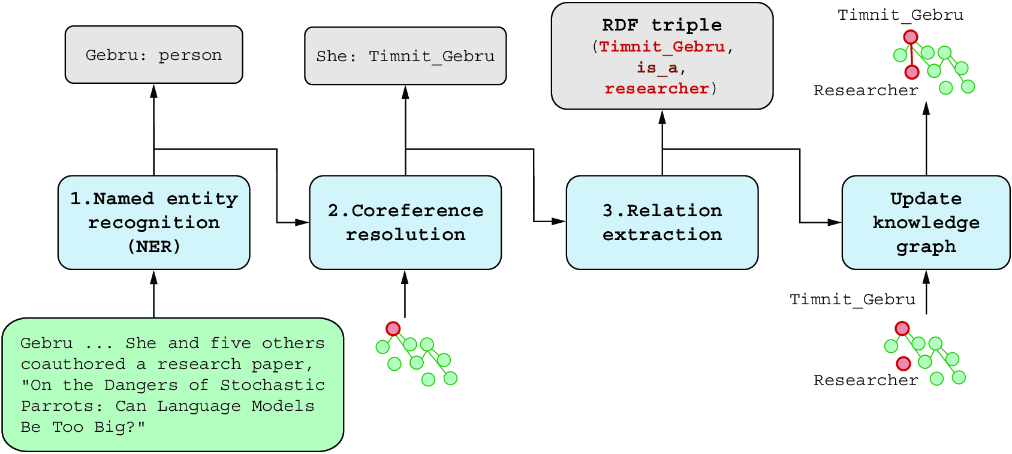
Use the four-stage pipeline figure to navigate the major components of knowledge extraction. section 11.3



