A student model learns to imitate a larger teacher model. In sequence-level distillation, the teacher answers domain-specific prompts, and the student is fine-tuned on those prompt–response pairs. This lets the student reproduce the teacher’s demonstrated behavior without access to its internal probabilities. section 5.4 section 5.4.1
Figure 5.6 The knowledge-distillation process
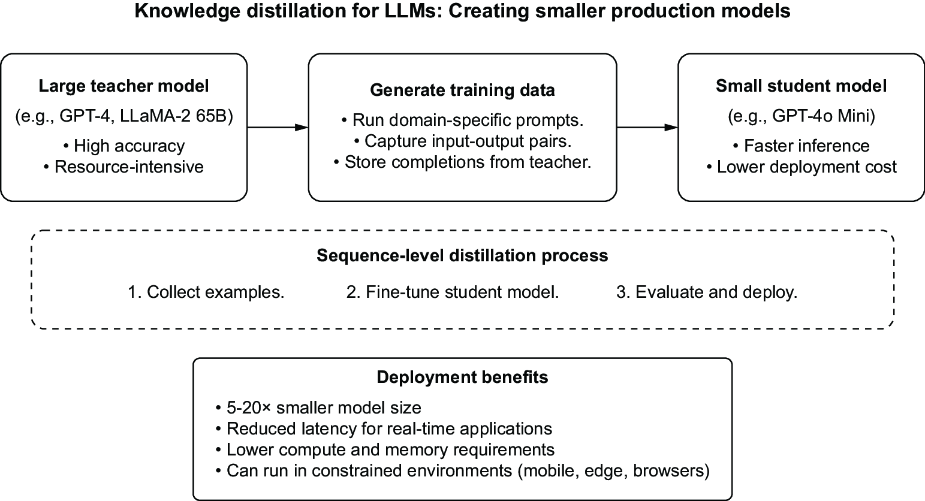
Use the process diagram to follow how teacher outputs become student training data. section 5.4.1
Distillation targets practical deployment constraints:
- Smaller models typically need less memory and compute, respond faster, and can run on more modest hardware. section 5.4.1
- Use a strong teacher and diverse real-world examples; evaluate tone, format, and correctness, then refresh training data as needs change. section 5.4.2 section 5.4.1
Customer-support responses
A teacher answers questions such as how to return a damaged product. Collect high-quality responses, fine-tune a smaller model on the pairs, and evaluate its accuracy and similarity before deployment. section 5.4.1 section 5.4.1

