Student model
A student model is a model trained with guidance from a teacher model to approximate its outputs, behavior, or learned capabilities.
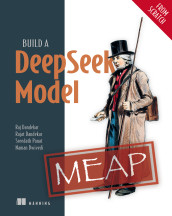
Build a DeepSeek Model (From Scratch)
A distilled model is a student model trained to reproduce capabilities or behavior transferred from a larger teacher model.
- How it is used
- Transfers a large teacher’s behavior into smaller models for practical deployment.
- How deep it goes
- Develops classical distillation through a runnable training loop and contrasts it with offline reasoning-trace fine-tuning.
- Examples
- Compares toy teacher and student networks and reports reasoning benchmark results for DeepSeek-R1 distilled models.
- What you can do after
- Build a toy knowledge-distillation pipeline from scratch in PyTorch and compare a distilled student with a hard-label baseline.
Read how Build a DeepSeek Model (From Scratch) explains student model →
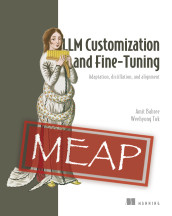
LLM Customization and Fine-Tuning
A student model is a smaller model trained to mimic a teacher model during distillation.
- How it is used
- Uses a cheaper student to reproduce teacher behavior without requiring the teacher at inference time.
- How deep it goes
- Walks through teacher-data filtering, student fine-tuning, inference, three-way evaluation, and independent safety checks.
- Examples
- Uses an IT support assistant with a Qwen student, a LoRA adapter, and a 50-example held-out comparison.
- What you can do after
- Apply it via SFTTrainer and LoRA to train and evaluate a student on teacher-generated responses.
Read how LLM Customization and Fine-Tuning explains student model →
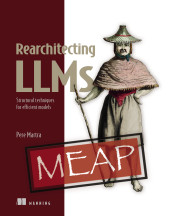
Rearchitecting LLMs
A student model is a model trained to reproduce a teacher model's behavior during knowledge distillation.
- How it is used
- Recovers capabilities lost when pruning a model for smaller size and faster inference.
- How deep it goes
- Walks through student construction, dataset preparation, KL-divergence training, and evaluation against original and pruned models.
- Examples
- Uses a pruned Gemma model trained on SlimPajama and a balanced mixture of Cosmopedia subsets for recovery.
- What you can do after
- Apply it via OptiPFair and PyTorch to construct, train, and evaluate a pruned student model.
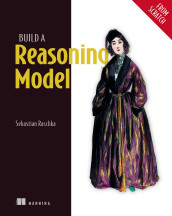
Build a Reasoning Model (From Scratch)
A smaller model trained to imitate a teacher model's reasoning traces and answers during distillation.
- How it is used
- Uses a larger reasoning teacher to transfer traces and answers into a cheaper, smaller model.
- How deep it goes
- Explains dataset construction, tokenization, cross-entropy training, validation, and hard-versus-soft distillation.
- Examples
- Uses DeepSeek-R1, Qwen3 0.6B, 12,000 MATH problems, and optional <think>...</think> reasoning tags.
- What you can do after
- Build it from scratch by preparing teacher traces, training a student, and evaluating checkpoints with validation loss and benchmarks.
Read how Build a Reasoning Model (From Scratch) explains student model →
AI Governance
A distilled model is a model trained to approximate the behavior of another model, often using that model’s outputs as training data.
- How it is used
- Frames output reuse as an after-release intellectual-property risk for exposed generative AI systems.
- How deep it goes
- Describes how API outputs become labeled training data and identifies contractual limits, without detailing distillation methods.
- Examples
- Cites an allegation that DeepSeek queried ChatGPT outputs to train a competing model.
- What you can do after
- Evaluate exposure by reviewing output-use terms for restrictions on scraping, bulk caching, and competitor training.
Building Reliable AI Systems
A model trained to imitate a teacher model, often with the aim of being smaller or more efficient.
- How it is used
- Reduces production cost and latency by transferring a teacher model’s behavior to a smaller model.
- How deep it goes
- Explains prompt–response fine-tuning but stops short of detailing model internals or training implementation.
- Examples
- Uses e-commerce support questions about damaged-product returns and exchanges as training examples.
- What you can do after
- Build it from scratch by collecting teacher responses and fine-tuning a smaller model on prompt–response pairs.
Read how Building Reliable AI Systems explains student model →
Also covered in
- Transformers in Action
- LLMs in Production
- Introduction to Generative AI, Second Edition
- Machines that ThinkIn early access (MEAP)
What to know first
- language modelA language model is a computational model that represents patterns in linguistic sequences to assign probabilities, predict, generate, or evaluate language.
- objective functionAn objective function is a mathematical function that assigns values to candidate solutions or parameter settings, which an optimization procedure seeks to minimize or maximize.
- distillationDistillation is a training technique in which a student model learns to approximate the outputs or behavior of a teacher model.
- fine-tuningFine-tuning is the continued training of a pretrained model on targeted data or objectives to adapt its parameters or behavior to a task, domain, or use.
Related concepts
- distillationused by · Distillation is a training technique in which a student model learns to approximate the outputs or behavior of a teacher model.
- foundation modelcontrasts with · A foundation model is a broadly trained machine-learning model whose learned capabilities can be reused or adapted for a range of downstream tasks.
- low-rank adaptationuses · Low-rank adaptation (LoRA) is a parameter-efficient fine-tuning technique that adapts a model by learning low-rank updates to its weights, typically while keeping most original weights fixed.
- teacher modeluses · A teacher model is a model whose outputs, behavior, or learned representations provide training signals for another model.
- labeluses · A label is a target value, category, or reference annotation associated with an example for learning, prediction, or evaluation.
Questions about student model
What is student model?
A student model is a model trained with guidance from a teacher model to approximate its outputs, behavior, or learned capabilities.
Which Manning books explain student model?
Build a DeepSeek Model (From Scratch), LLM Customization and Fine-Tuning, Rearchitecting LLMs, Build a Reasoning Model (From Scratch), AI Governance and Building Reliable AI Systems.
What should I know before learning student model?
Manning books that teach student model usually introduce language model, objective function, distillation and fine-tuning first.
What is the difference between student model and foundation model?
A student model is a model trained with guidance from a teacher model to approximate its outputs, behavior, or learned capabilities. A foundation model is a broadly trained machine-learning model whose learned capabilities can be reused or adapted for a range of downstream tasks.
These guides are generated from the text of Manning books by Manning's knowledge graph and link to the sections they draw on. The full books are available on liveBook and at manning.com.