liveBook · Manning

Subject

As explained in Fundamentals of Cybersecurity

A subject is an individual, application, service, device, or other active entity that requests or attempts to access a resource.

A subject is the active entity that requests access to a resource. It may be an individual user, application, process, service, device, or database query. Access control evaluates the subject together with the requested object and the rules that allow or deny access. section 8.2 section 8.11

Common subjects include:

  • A user logging into a system. section 8.2
  • An application, script, or database query requesting data. section 8.2
  • A workstation, smartphone, or other device connecting to a service or network. section 8.2

A simple access request

When a user requests a file, the user is the subject, the file is the object, and the rules determine whether the request is permitted. The same pattern applies when a script queries a database or a device connects to a network. section 8.2 section 8.11

Figure 8.1 Illustration of the relationship between subject, objects, and rules.
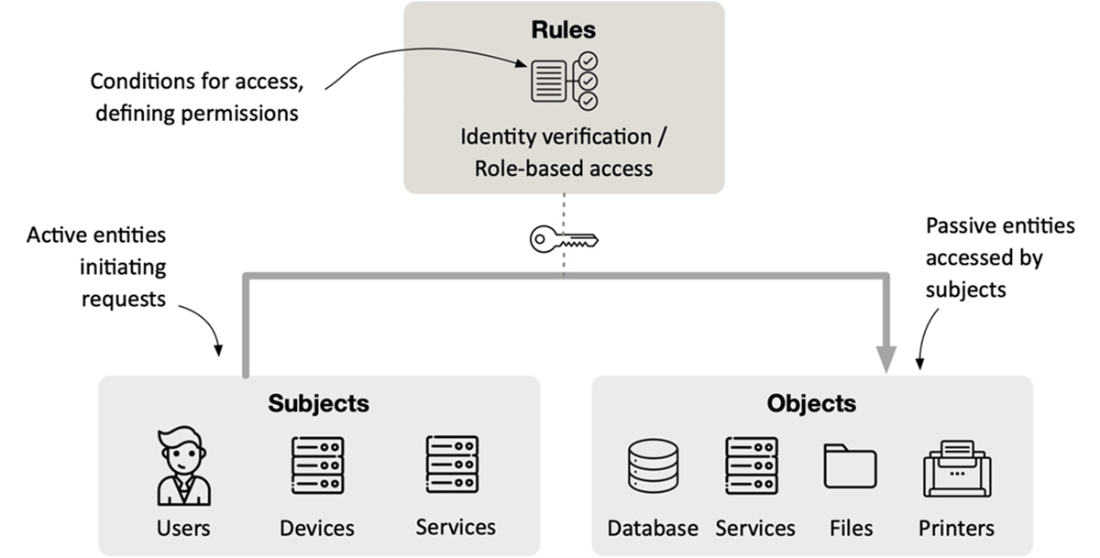
Use the relationship diagram to distinguish the requesting subject from the protected object and the rules governing access. section 8.2


How Fundamentals of Cybersecurity covers it

How deep it goes
Defines subjects as active entities and distinguishes them from passive objects within the access-control framework.
Examples
Uses users, applications, scripts, database queries, workstations, smartphones, and network-connected devices as subjects.
What you can do after
Evaluate access requests by identifying the requesting entity before applying authentication, authorization, and access rules.
How it connects
Connects subjects to objects, rules, identification, authentication, authorization, accountability, IAM, and PAM.

Also explained in

Compare how 3 books explain subject →

Related concepts

This explainer was generated by Manning's knowledge graph from the text of Fundamentals of Cybersecurity. The section links point to the parts of the book it draws on.
