Swarm intelligence solves difficult problems through the collective behavior of many simple agents. Like ants, birds, or bees, the individuals follow limited rules, yet their interactions produce useful group-level behavior. section 1.20 section 6.1
The approach is useful when a problem requires searching among many possible solutions. It includes ant-inspired pathfinding and animal-inspired optimization, rather than relying on one highly intelligent decision-maker. section 1.20 section 6.0
Core ideas include:
- Use local signals to coordinate behavior. Ants release pheromones that other ants sense, changing how they move and creating group-level organization. section 6.1
- Let repeated activity strengthen promising choices. In the bridge experiment, ants using the shorter route make more trips and deposit pheromones faster, causing the colony to favor that route. section 6.1
- Model groups with simple behavioral rules. Bird-flock models use alignment with neighbors and cohesion toward the group, while particle swarm optimization adapts the same collective-search intuition to difficult problems. section 7.1
Finding a short route
Imagine ants choosing between two bridges from a nest to food. The ants initially explore both routes, but ants on the shorter bridge return sooner and complete more trips. Their greater pheromone deposit attracts more ants, so the colony gradually converges on the shortest path. section 6.1
Figure 6.2 Asymmetric bridge experiment
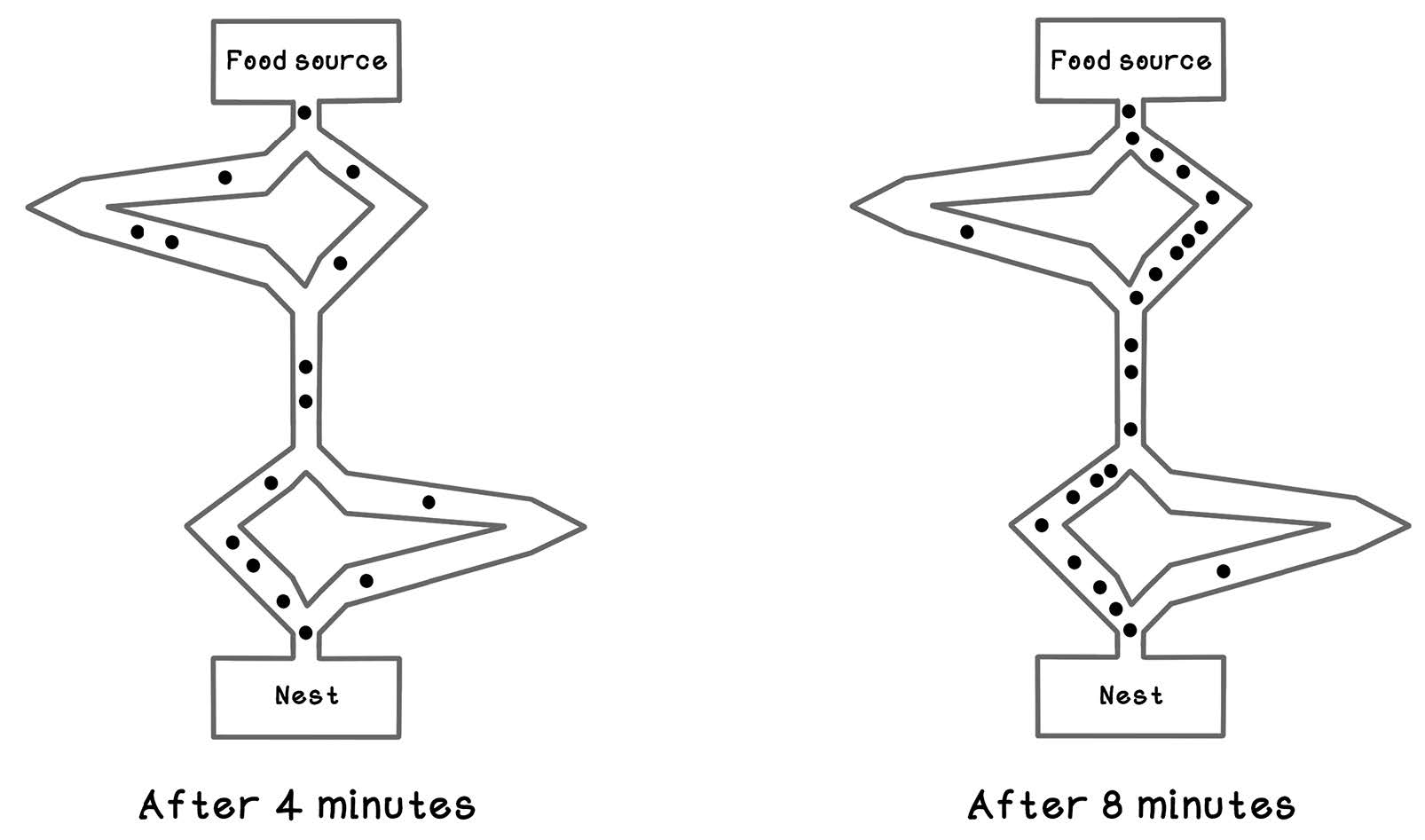
Use the asymmetric bridge experiment to visualize how unequal travel times amplify pheromone trails and guide collective path selection. section 6.1

