Swarm intelligence is a way to solve complex problems through the collective behavior of many relatively simple agents. The agents interact with one another and their environment without a central coordinator. In optimization, a population of agents uses cooperation, communication, and self-organization to search for an optimal or near-optimal solution. section 9.1 section 7.1
A cooperative treasure hunt
Imagine friends searching an island together. Rather than dismissing weaker treasure hunters and recruiting replacements, everyone stays in the search. Hunters share information and give more weight to those finding promising areas. This illustrates the contrast with genetic algorithms, which select better-performing individuals to produce a new population. section 9.0 section 2.2
A general swarm-intelligence loop is:
- Initialize the parameters and the swarm. section 9.1
- Until a stopping criterion is met, loop over the individuals, find the best result so far and the best neighbor, then update each individual. section 9.1
The idea covers several algorithms, not one fixed update rule. Particle swarm optimization draws on bird flocking and fish schooling; ant colony optimization draws on ant foraging; and artificial bee colony draws on honeybee foraging. Particle swarm optimization has continuous, binary, permutation-based, and adaptive variants for different kinds of optimization problems. section 9.1 section 9.0
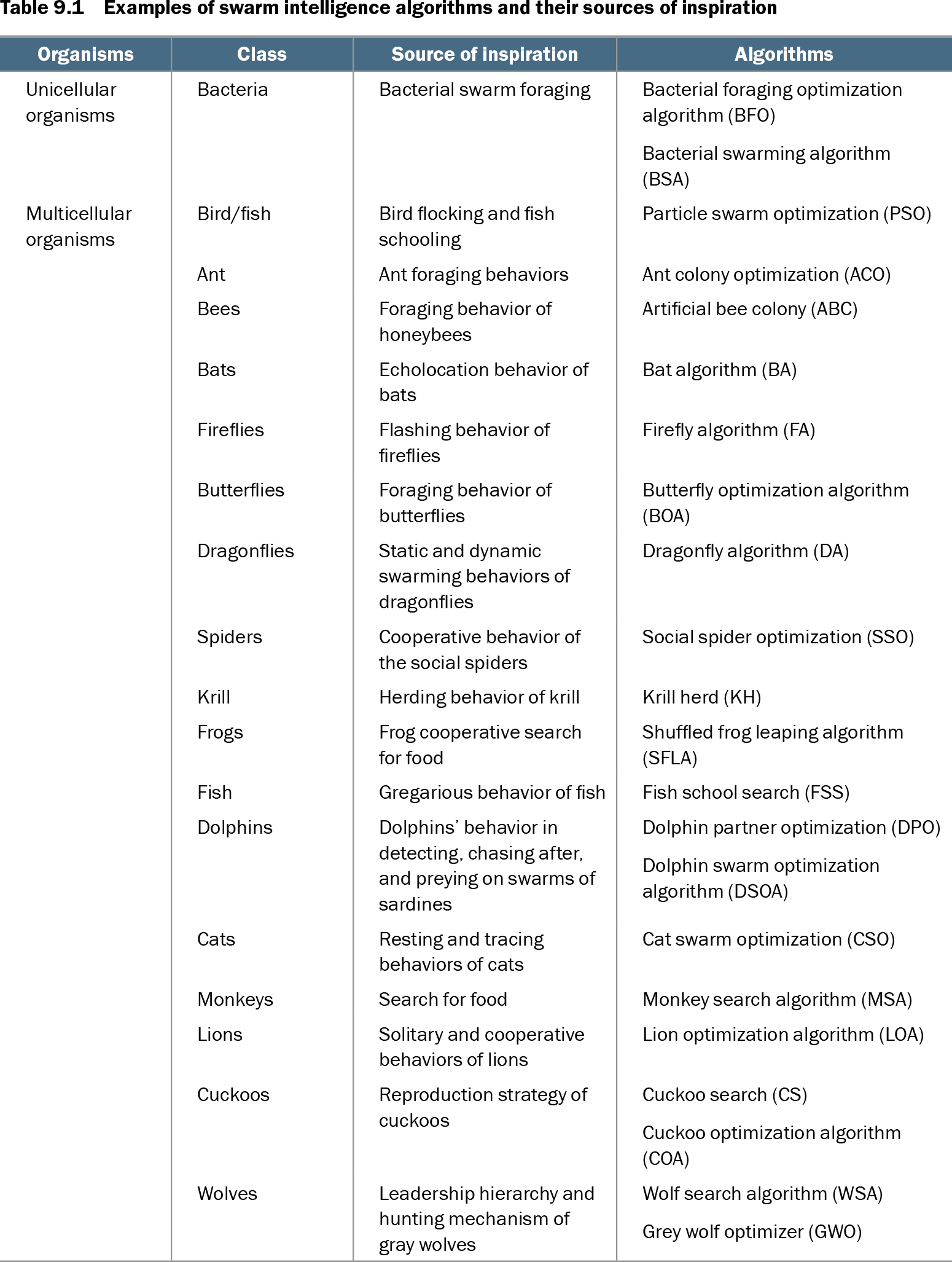
Table 9.1 Examples of swarm intelligence algorithms and their sources of inspiration (view table figure)
| Organisms |
Class |
Source of inspiration |
Algorithms |
|---|---|---|---|
| Unicellular organisms |
Bacteria |
Bacterial swarm foraging |
Bacterial foraging optimization algorithm (BFO) Bacterial swarming algorithm (BSA) |
| Multicellular organisms |
Bird/fish |
Bird flocking and fish schooling |
Particle swarm optimization (PSO) |
| Ant |
Ant foraging behaviors |
Ant colony optimization (ACO) |
|
| Bees |
Foraging behavior of honeybees |
Artificial bee colony (ABC) |
|
| Bats |
Echolocation behavior of bats |
Bat algorithm (BA) |
|
| Fireflies |
Flashing behavior of fireflies |
Firefly algorithm (FA) |
|
| Butterflies |
Foraging behavior of butterflies |
Butterfly optimization algorithm (BOA) |
|
| Dragonflies |
Static and dynamic swarming behaviors of dragonflies |
Dragonfly algorithm (DA) |
|
| Spiders |
Cooperative behavior of the social spiders |
Social spider optimization (SSO) |
|
| Krill |
Herding behavior of krill |
Krill herd (KH) |
|
| Frogs |
Frog cooperative search for food |
Shuffled frog leaping algorithm (SFLA) |
|
| Fish |
Gregarious behavior of fish |
Fish school search (FSS) |
|
| Dolphins |
Dolphins’ behavior in detecting, chasing after, and preying on swarms of sardines |
Dolphin partner optimization (DPO) Dolphin swarm optimization algorithm (DSOA) |
|
| Cats |
Resting and tracing behaviors of cats |
Cat swarm optimization (CSO) |
|
| Monkeys |
Search for food |
Monkey search algorithm (MSA) |
|
| Lions |
Solitary and cooperative behaviors of lions |
Lion optimization algorithm (LOA) |
|
| Cuckoos |
Reproduction strategy of cuckoos |
Cuckoo search (CS) Cuckoo optimization algorithm (COA) |
|
| Wolves |
Leadership hierarchy and hunting mechanism of gray wolves |
Wolf search algorithm (WSA) Grey wolf optimizer (GWO) |
Compare swarm algorithms by organism and behavior that inspired them, from bacterial foraging to flocking, ant foraging, and bee foraging. section 9.1
A diverse initial population helps population-based search explore solutions that a single-trajectory search might miss. Initialization strategies trade off diversity, computational cost, and initial solution quality. That is a practical design choice, not a promise of finding the global optimum. section 7.1 section 7.5