A system boundary marks where responsibilities and dependencies separate. In hexagonal architecture, it divides the business-logic core from external concerns such as databases, user interfaces, frameworks, and APIs. Keeping the core independent makes it easier to change or extend the outside without rewriting business logic. section 5.2.2 section 5.4
Boundaries matter in different ways depending on what crosses them:
- At the core’s edge, ports define how outside components can communicate with business logic; adapters connect those ports to specific technologies. section 5.10
- At a network boundary, an in-memory call becomes a slower, less reliable request. Each crossing brings potential latency, failure, and complexity. section 6.2.1
- Architectural guardrails can detect boundary violations in CI. A ratchet gate can prevent new violations without requiring a legacy system to fix every existing one first. section 13.4.4
Add an adapter, keep the core
A hexagonal application can gain a mobile app or admin CLI through new adapters connected to defined ports. The business logic stays unchanged. That flexibility depends on keeping outside implementation details from leaking across the boundary. section 5.4
Ratchet down legacy violations
If a codebase has 85 boundary violations, set the CI threshold at 85. A change that raises the count to 86 fails; reducing it to 78 lowers the threshold. The limit moves toward fewer violations, not more. section 13.4.4
Figure 5.10 The Extensible Hexagon. Because the Application Core only communicates through defined Ports, you can easily plug in new "Future Adapters" (like a Mobile App or Admin CLI) without modifying a single line of your existing business logic.
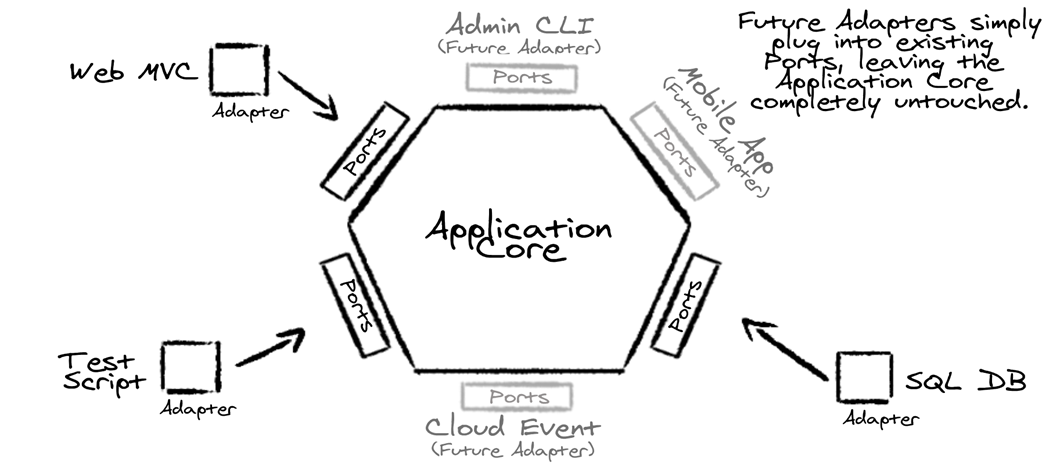
The diagram shows how defined ports let new adapters connect without changing the application core. section 5.4








