A tangent line touches a curve at a point and captures its instantaneous direction there. Its slope measures how rapidly the function grows or declines at that point. Geometrically, shrinking an interval around the point turns the secant line’s average slope into the tangent line’s slope—the derivative. section 5.1.1
Use tangent slopes to:
- Measure a curve’s local incline or decline at a chosen point. section 5.1.1
- Join polynomial pieces smoothly by requiring matching tangent slopes at their shared point. section 7.1.1
- Add curvature constraints by relating the curve’s second derivative to its shape at a point. section 7.1.1
A smooth polynomial join
Suppose a polynomial P(x) must pass through two points and have tangent slope -1 at both. For a cubic P(x) = ax³ + bx² + cx + d, impose P(1) = 1, P(3) = 2, P′(1) = -1, and P′(3) = -1. Solving the resulting linear system produces a curve that interpolates the points while matching the prescribed tangent directions. section 7.1.1
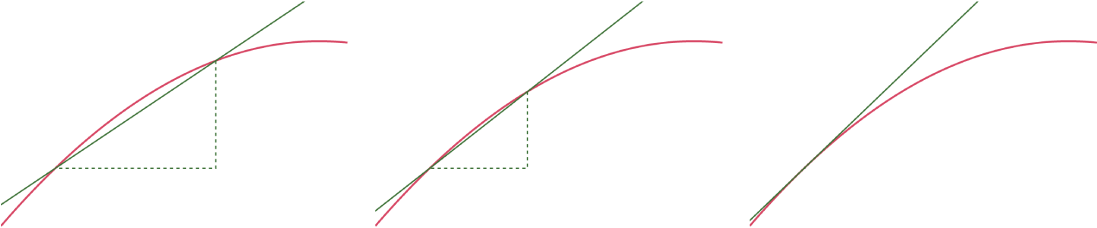
Visualize how a shrinking interval makes a secant line approach the tangent line. section 5.1.1
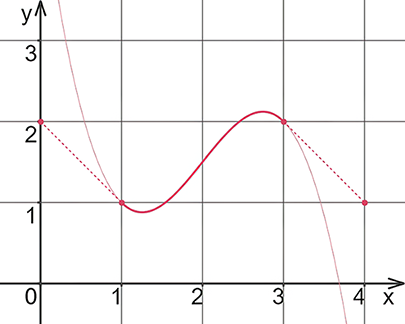
Inspect a cubic determined by two points and two tangent constraints. section 7.1.1

