A team topology is an arrangement of teams and their interactions. It matters because software boundaries alone cannot create fast flow: if teams must repeatedly change the same code or coordinate deployments, organizational friction remains. Aim to align team responsibilities and software boundaries around value streams that can move as independently as practical, while recognizing that some dependencies will remain. section 11.0 section 11.1.6
Team Topologies provides principles and patterns for shaping that arrangement. Its patterns describe four team types and three interaction modes, but labels are not a substitute for the principles behind them. A stream-aligned team, for example, owns a value stream from discovering user needs through operating its software. Shared platform capabilities can reduce the cognitive load that would otherwise distract such teams from their core work. section 11.2 section 11.2.1
An overloaded integration team
At a global cosmetics brand, an integration platform team built and maintained custom endpoints for several other teams. Mapping its interactions revealed collaboration with at least four teams. The coordination required exceeded its capacity, making it a bottleneck. The map made the problem discussable without treating the team’s effort as the cause. section 11.2.3
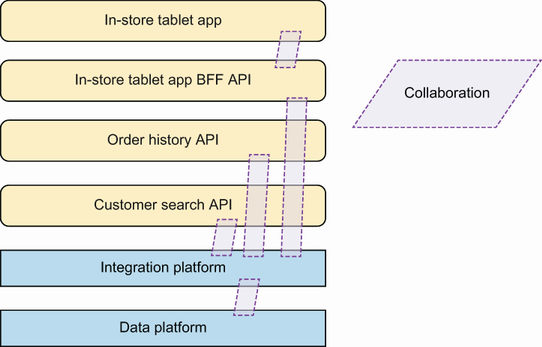
Use the interaction map to see how multiple collaboration relationships concentrated coordination on the integration platform team. section 11.2.3
To examine a candidate topology together:
- Map teams against their value streams and software boundaries. Look for shared code, synchronized deployments, and decisions outside a team that interrupt its flow. section 11.0 section 11.1.6
- Identify each team’s role and its interactions. If a team appears to occupy several roles, ask whether its responsibilities are too broad; do not force an existing team into a label. section 11.2.1
- Check whether responsibilities and coordination demands fit the team’s cognitive load. Revisit the map as needs change rather than treating a reorganization as a finished design. section 11.6 section 11.4

