A team topology defines distinct team types and interaction boundaries so teams can access capabilities without unnecessary intrateam communication. It aligns ownership with business value, platform users, specialized subsystems, or temporary capability-building relationships. section 3.1.1
The framework distinguishes four team types:
- Stream-aligned teams own an end-to-end flow of work for a specific business or customer value stream and maintain the resulting service. section 3.1.1
- Platform teams serve internal stream-aligned teams through capabilities such as self-service infrastructure, tooling, and shared services. section 3.1.1 section 10.3.2
- Complicated subsystem teams own technically complex areas requiring specialized expertise that is difficult to distribute across other teams. section 3.1.1
- Enabling teams temporarily provide expertise and guidance while helping stream-aligned teams build capability and share knowledge. section 3.1.1
Epetech’s team restructuring
Epetech formed e-commerce, mobile app, and inventory management stream-aligned teams with development-to-production ownership. A dedicated platform team provided self-service resource provisioning, CI/CD pipelines, logging, monitoring, authentication, and authorization, reducing cognitive load for the stream-aligned teams. section 10.3.2
Figure 3.1 The stream-aligned teams are domain-bounded, but so are the platform team and subsystem team. (Image taken from [1]. Used with permission.)
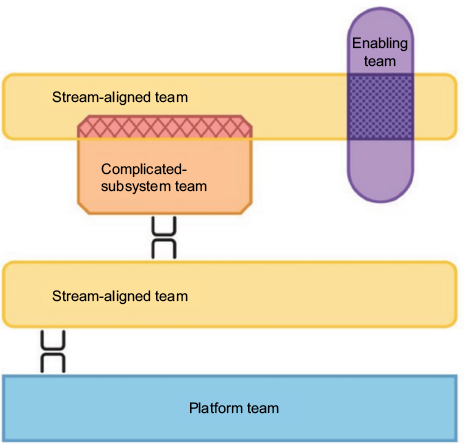
Use the figure to compare the domain boundaries around stream-aligned, platform, and complicated subsystem teams. section 3.1.1

