Feasibility is the assessment of whether a proposed project can be carried out under its available technical, organizational, infrastructure, data, and funding conditions. Frame the idea as a hypothesis and investigation, then turn uncertainty into explicit diligence actions. section 3.1
Assess feasibility by checking:
- Stakeholder availability, accessible and manageable data, team capacity, relevant skills, and the size of any capability gap. section 3.1
- Technical risk, project novelty, implementation difficulty, customer infrastructure, and mitigations for substantial gaps. section 3.1
- Whether sufficient funding exists for the complete project, separately from the value or savings the project might create. section 3.1
- During sprint 0, request access, information, and accounts; resolve blockers and revisit feasibility and estimates with better project knowledge. section 4.0
Customer-churn hypothesis
A team can test whether data from a specified table can produce a customer-churn model, while investigating how that model would operate within the business. The hypothesis exposes technical, data, and utilization questions for diligence. section 3.1
Figure 3.1 The project’s drivers (Business Priority and Business Case), the supporting components (Sufficient Funding, Technical Means, and Data Resource), and enablers (Utilization Method).
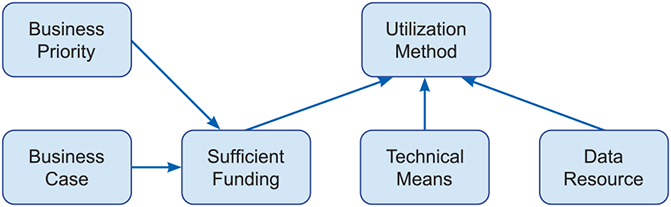
Use the project-driver diagram to relate business priority and business case to sufficient funding, technical means, data resources, and the utilization method. section 3.1



