Temporal autocorrelation means that an observation is correlated with earlier observations of the same target, and often with earlier values of its explanatory features. This breaks the assumption that rows are independent and identically distributed (IID): a model may mistake time-driven patterns for ordinary feature relationships. section 2.1.1
Control temporal effects by:
- Transforming a date or time interval into a usable time feature, such as Unix time, and applying time-series cross-validation. section 2.1.1
- Creating lagged or pivoted features that represent values at earlier moments, such as sales_month_1 and sales_month_2. section 2.1.1
Figure 2.1 Comparison of IID and non--IID data sequences. The left chart shows IID data, while the right chart illustrates non-IID data, highlighting the sequential correlation patterns.
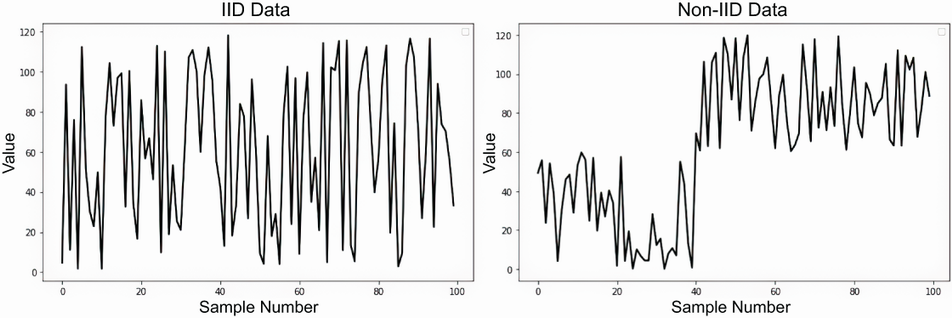
Compare IID and non-IID sequences visually to see how sequential correlation changes the structure of observations. section 2.1.1



