liveBook · Manning

Indexing

As explained in Context Engineering

Indexing organizes information into a structure that supports efficient search and retrieval.

In production RAG, indexing partitions content into chunks, computes embeddings, and populates index partitions so knowledge stores can support retrieval. Changed records can be updated incrementally to limit stale context. section 9.3.5

Operational indexing includes:

  • Evaluate candidate indexes against golden test sets using retrieval precision, recall, and semantic similarity. section 9.3.5
  • Validate coverage against evolving vocabulary, multi-hop queries, and real-world user intent. section 9.3.5
  • Roll out index updates through A/B tests or canaries, comparing retrieval precision and generation groundedness. section 9.3.5
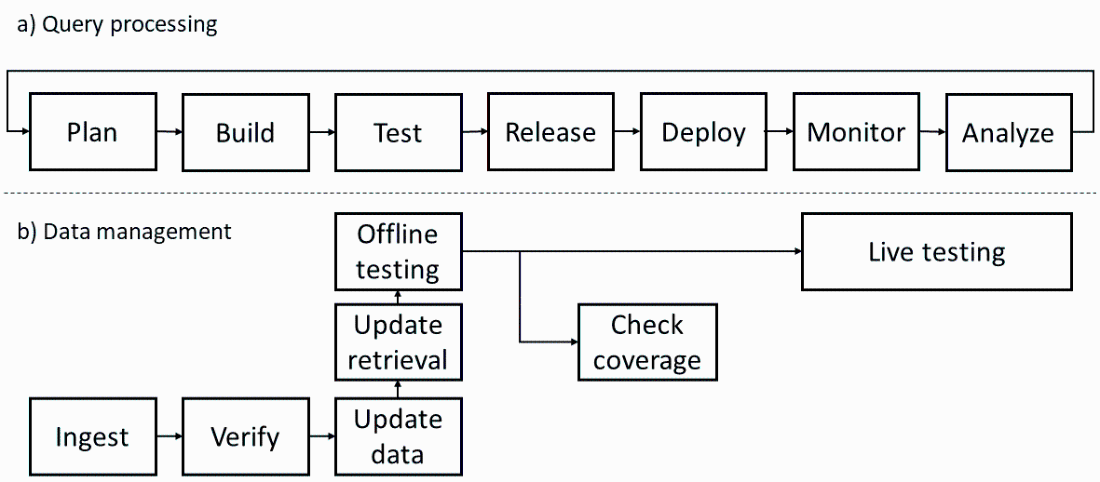
Figure 9.5 RAGOps workflows for the query-processing pipeline and the data-management pipeline in production RAG systems
ragops v1

Shows how the data-management indexing workflow connects with runtime query processing in production RAG. section 9.3.5


How Context Engineering covers it

How deep it goes
Details chunking, embeddings, incremental updates, evaluation, and rollout, but not index structures.
Examples
Uses changed records, golden test sets, and production traffic to evaluate and roll out index updates.
What you can do after
Operate indexing by evaluating candidate indexes and releasing updates through A/B tests or canary rollouts.
How it connects
Connects document ingestion, embeddings, vector stores, retrieval evaluation, and RAG operations.

Also explained in

Compare how 22 books explain indexing →

Related concepts

This explainer was generated by Manning's knowledge graph from the text of Context Engineering. The section links point to the parts of the book it draws on.