A slice is a borrowed view of a contiguous region of elements. It holds a pointer to the first element and a length; it does not own or copy the underlying data. A string slice, `&str`, is a read-only view of string data. Several `&str` values can point to different parts of the same `String`. section 4.4.2 section 4.7
Figure 4.8 Taking multiple slices of the same string
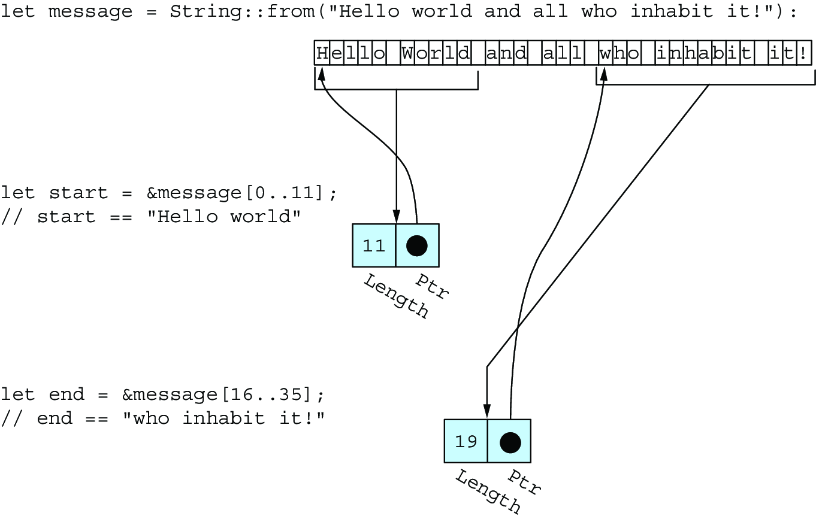
The figure shows multiple string slices pointing into one `String`, rather than each holding a separate copy. section 4.4.2
That distinction matters when choosing between borrowing and ownership. Getting an `&str` from a `String` is cheap: the view needs only the buffer’s starting pointer and length. Calling `.to_string()` on an `&str` instead creates an owned `String`, allocating a buffer and copying the data. Substring operations on `&str` need not reallocate memory. section 2.4.1 section 3.3
Borrowing an NGINX request body
A function returning `Result<&'a str, &'static str>` from a `&'a ngx_http_request_t` ties the returned string slice to the request’s lifetime. The slice views memory owned by the request; it cannot remain valid after that request is deallocated. section 4.4.2
To form a view of request memory reached through C pointers:
- Check that the request-body buffer pointers are initialized before following them. section 4.4.2
- Determine the region’s length from its start and end pointers using `.offset_from`. section 4.4.2 section 4.7
- Use `std::slice::from_raw_parts` to construct a slice from a pointer and length. Because raw-pointer operations can require `unsafe`, the developer must uphold the memory-safety rules the compiler cannot check. section 4.7 section 3.3















