A test runner finds tests in your code, executes them automatically, reports their status, and helps reveal why failures occurred. It removes the repetitive work of manually running tests. section 2.3
A runner typically helps you:
- Execute one test or an entire test suite. section 2.3
- Repeat tests quickly and consistently, making it easier to catch small but significant bugs. section 2.3
- Review counts, failed tests, failure reasons, code locations, and sometimes stack traces. section 2.3
Running a group of tests with Jest
Jest combines a test runner with a test library, assertion library, and reporter. Use its --testPathPattern flag to run a selected group of tests rather than every test. section 2.2 section 2.12
Figure 2.4 Unit tests are written as code, using libraries from the unit testing framework. The tests are run from a test runner inside the IDE or through the command line, and the results are reviewed through a test reporter (either as output text or in the IDE) by the developer or an automated build process.
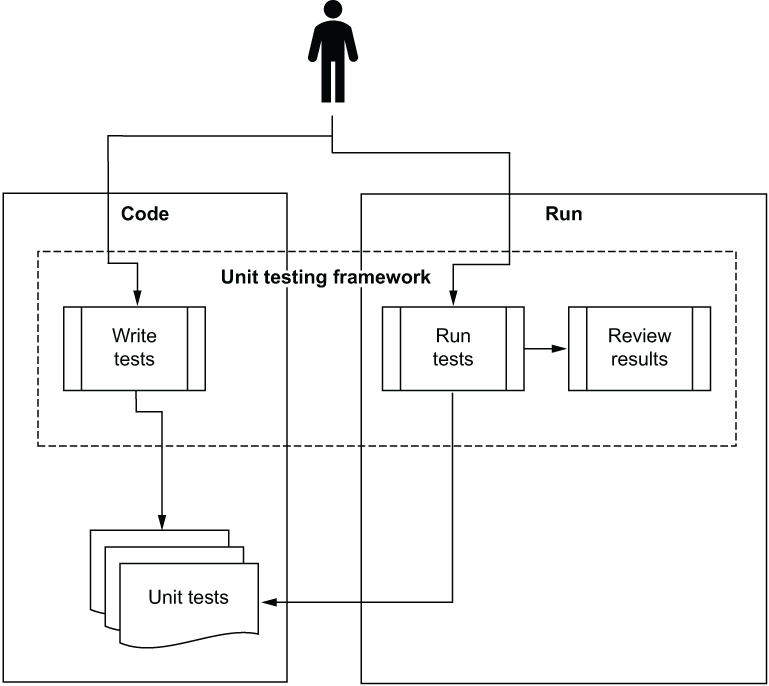
Trace the workflow from tests written as code, through runner execution in an IDE or command line, to results reviewed by a developer or automated build process. section 2.3




