liveBook · Manning

Testing pyramid

As explained in Think Like a Software Engineering Manager

The testing pyramid is a test-suite design framework that emphasizes an appropriate distribution of automated tests across testing levels.

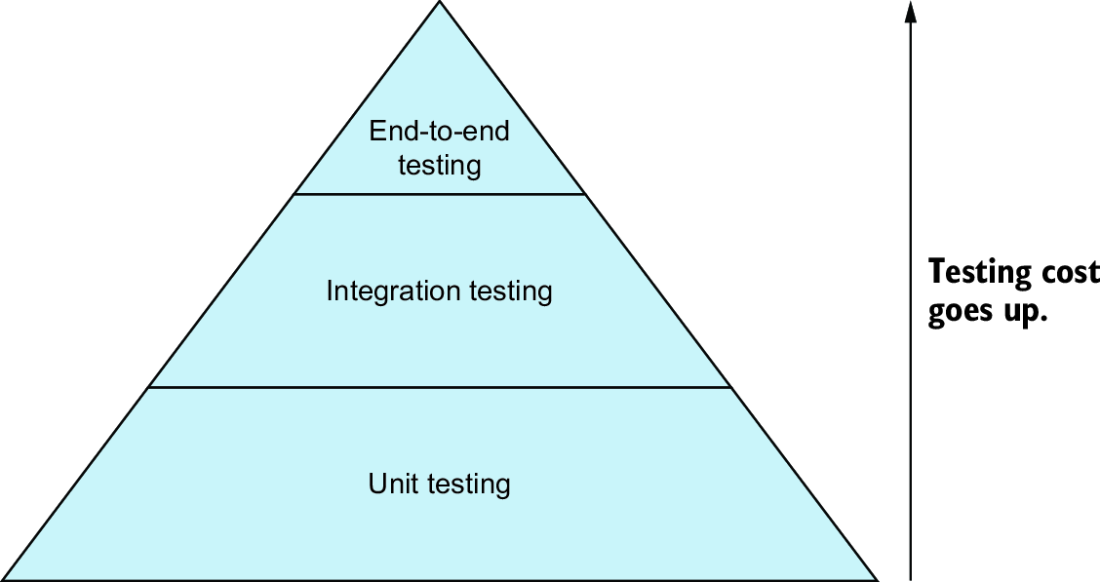
The testing pyramid is a framework for designing an automated test suite across three levels: unit testing at the base, integration testing in the middle, and end-to-end testing at the top. It supports regression testing and helps teams protect changes before they reach users. section 12.2.2

Use the pyramid to make testing repeatable and part of everyday delivery:

  • Automate test cases so they can be rerun with minimal manual intervention. section 12.2.2
  • Run tests through continuous integration tools with each code commit. section 12.2.2
  • Treat testing as a safeguard and quality measure before changes reach users. section 12.2.2
The test automation pyramid helps the engineering team produce high-quality software. It works at three levels: unit testing (base step), integration testing (middle step)m and end-to-end testing (top).
sidebar figure

Inspect the three-level pyramid: unit testing forms the base, integration testing the middle, and end-to-end testing the top. section 12.2.2


How Think Like a Software Engineering Manager covers it

How deep it goes
Defines three testing levels and their pyramid positions, but does not provide implementation details or distribution ratios.
Examples
Uses a three-level pyramid figure, commit-triggered tests, and Netflix Chaos Monkey as testing-automation examples.
What you can do after
Apply it by building repeatable automated tests and integrating them into the development workflow.
How it connects
Connects unit testing, integration testing, end-to-end testing, regression testing, continuous integration, and automation testing.

Also explained in

Compare how 8 books explain testing pyramid →

Related concepts

This explainer was generated by Manning's knowledge graph from the text of Think Like a Software Engineering Manager. The section links point to the parts of the book it draws on.





