Traditional machine learning covers non-neural approaches for mapping tabular inputs to predictions. It includes methods based on statistical optimization or similarity comparisons, from linear regression to gradient-boosting decision trees. For business data stored in CSV files or relational tables, these methods can predict inventory needs, commodity prices, listing prices, and other operational targets. section 1.0 section 1.6
Feature engineering is central: transform raw columns into representations a model can use, retain informative signals, reduce noise, address nonlinear relationships, and incorporate domain knowledge. This work matters because model assumptions and data characteristics determine whether a representation is useful. section 1.3
Choose traditional machine learning when its trade-offs fit the problem:
- Use linear models as a challenging baseline and as robust production candidates. section 4.0
- Consider gradient boosting, including XGBoost, as a conventional choice for tabular data. section 1.6
- Give it particular consideration for smaller datasets, where deep learning may struggle with limited rows and many parameters. section 12.1
- Compare alternatives on simplicity, transparency, and efficacy rather than treating either classical or deep learning as universally best. section 3.0
Airbnb price prediction
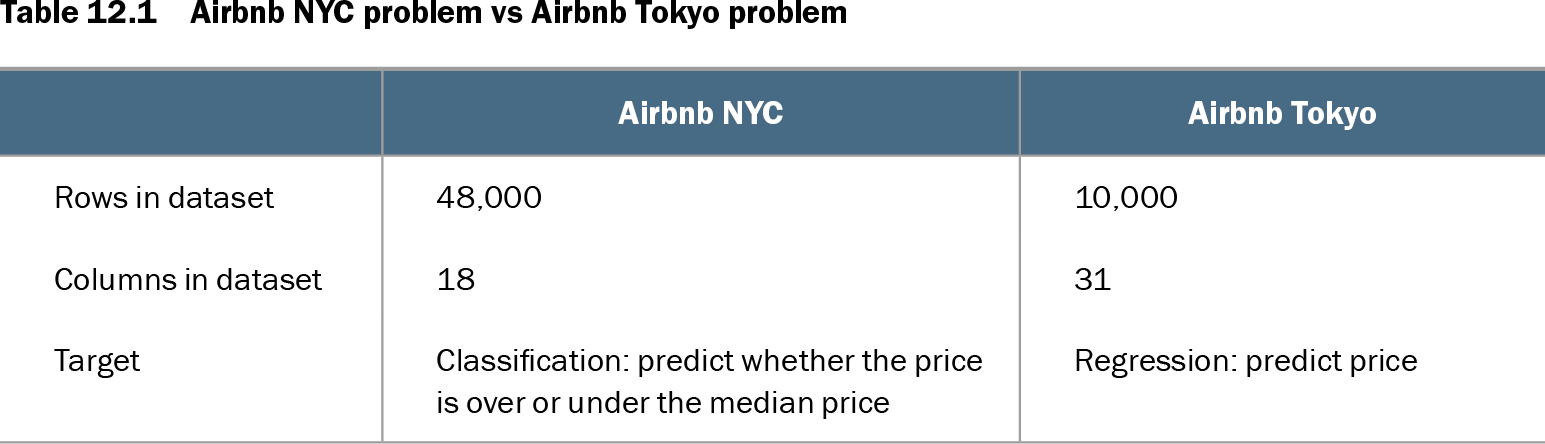
A Tokyo Airbnb regression task has 10,000 rows and 31 columns, compared with 48,000 rows and 18 columns for an NYC classification task. More columns increase preprocessing and feature-engineering demands; fewer rows can favor classical approaches. An optimized XGBoost result substantially improved on a linear-regression baseline, reaching R-squared 0.729 versus 0.320. section 12.1 section 12.1
Table 12.1 Airbnb NYC problem vs Airbnb Tokyo problem (view table figure)
| Airbnb NYC |
Airbnb Tokyo |
|
|---|---|---|
| Rows in dataset |
48,000 |
10,000 |
| Columns in dataset |
18 |
31 |
| Target |
Classification: predict whether the price is over or under the median price |
Regression: predict price |
Compare the row counts, column counts, and prediction targets that shape the Airbnb modeling trade-off. section 12.1
Generative AI can assist with tabular workflows involving textual input or output, but it is not yet a general replacement for supervised classical models in tabular prediction. A cited benchmark reports stronger average F1 for XGBoost trained on all data than for few-shot ChatGPT or Flan-T5 on its prediction tasks. section 1.5