Transductive learning optimizes embeddings or predictions for a fixed set of nodes and the graph structure observed during training. It suits static graphs where new nodes are not expected, and can infer labels or edges among known nodes. section 11.1.1
Figure 11.1 The node embedding problem. The goal of the task is to learn an encoding function, encode(x), that maps nodes to a multidimensional embedding space. These embeddings are optimized so that distances in the embedding space reflect relevant aspects of the original graph, such as the relative positions of the nodes.
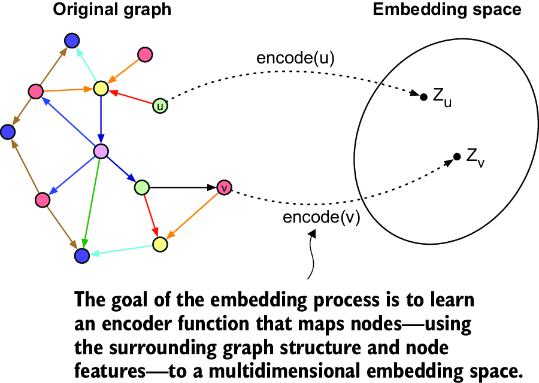
The node-embedding view makes the objective concrete: map observed nodes into a multidimensional space whose distances preserve relevant graph relationships. section 11.1.1
Use transductive learning when the graph’s membership is stable:
- Classify unlabeled nodes from patterns learned across partially labeled nodes. section 11.1.1
- Predict new edges between nodes already observed during training. section 11.1.1
- Recommend existing products to existing users from their past interactions. section 11.1.1
Fixed graph, changing relationships
A shallow embedding model can represent members of a known karate club and learn relationships among them. If a new member joins, the lookup table cannot automatically provide an embedding; retraining is required. section 11.3.2
The central trade-off is generalization. Transductive methods can fit the observed graph well but do not learn a reusable rule for unseen nodes. Inductive methods instead learn parametric mappings from node features and can apply them to nodes absent during training. section 11.1.1


