A transposed convolution is a learnable layer that projects a low-resolution feature map into a larger one. Unlike nearest-neighbor interpolation, which duplicates pixels, it uses trainable filters to reconstruct useful detail. section 12.19
The upsampling process works like this:
- Take one pixel at a time from the small feature map. section 12.19
- Use a learnable filter to paint a larger patch on the output map rather than producing only one output pixel. section 12.19
- Repeat the operation for every input pixel and add values where painted patches overlap. section 12.19
- Learn the filter weights during training so the layer can reconstruct cleaner, more coherent detail. section 12.19
From 4×4 to 8×8
A decoder receives sixteen 4×4 feature maps from a compressed bridge. A transposed-convolution layer enlarges them to sixteen 8×8 maps, carrying image data together with text-label and timestep embeddings. In a simple implementation, a filter size of 4, stride of 2, and padding of 1 produce the doubled spatial dimensions. section 12.19
Figure 12.41 The upsampling layer in our U-Net
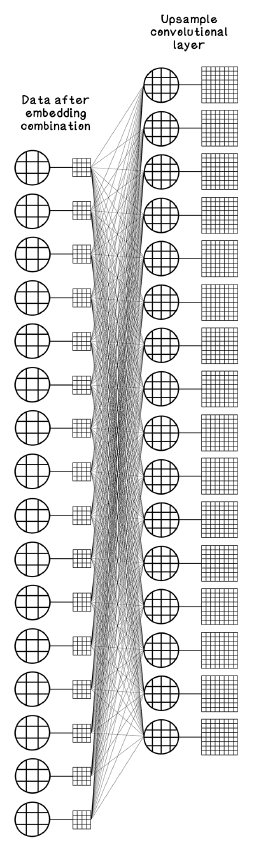
View the U-Net upsampling layer alongside the feature-map transition from compressed representations to larger maps. section 12.19




