A trend is a long-term movement or systematic directional change in a time series. Trends can make the mean and other statistical properties vary over time, producing nonstationary data that complicates forecasting. section 7.3.6 section 7.3.5
Use trend treatment according to the modeling task:
- Apply first-order differencing by subtracting each observation from its predecessor; this removes trend-related nonstationarity but reduces the record count by one. section 7.3.6
- Use double exponential smoothing (DES), or Holt’s linear trend model, when the series has an underlying linear trend. section 7.4.6
- Use Holt–Winters smoothing when trend occurs with seasonality; choose additive or multiplicative seasonality according to whether seasonal variation is constant or changing. section 7.4.4
- Treat simple exponential smoothing as inappropriate for clear trends because it models level without an explicit trend component. section 7.4.6
Differencing Apple closing prices
For prices [173.300247, 171.953735, 173.210495, 174.457260, 177.030579], first-order differencing produces [-1.346512, 1.256760, 1.246765, 2.573319]. Each result subtracts the previous price from the current price, so the output contains one fewer observation. section 7.3.6
Figure 7.2 Four illustrative time series charts. Three of the subplots display nonstationary data; in contrast, the plot in the lower-right quadrant displays stationary time series data.
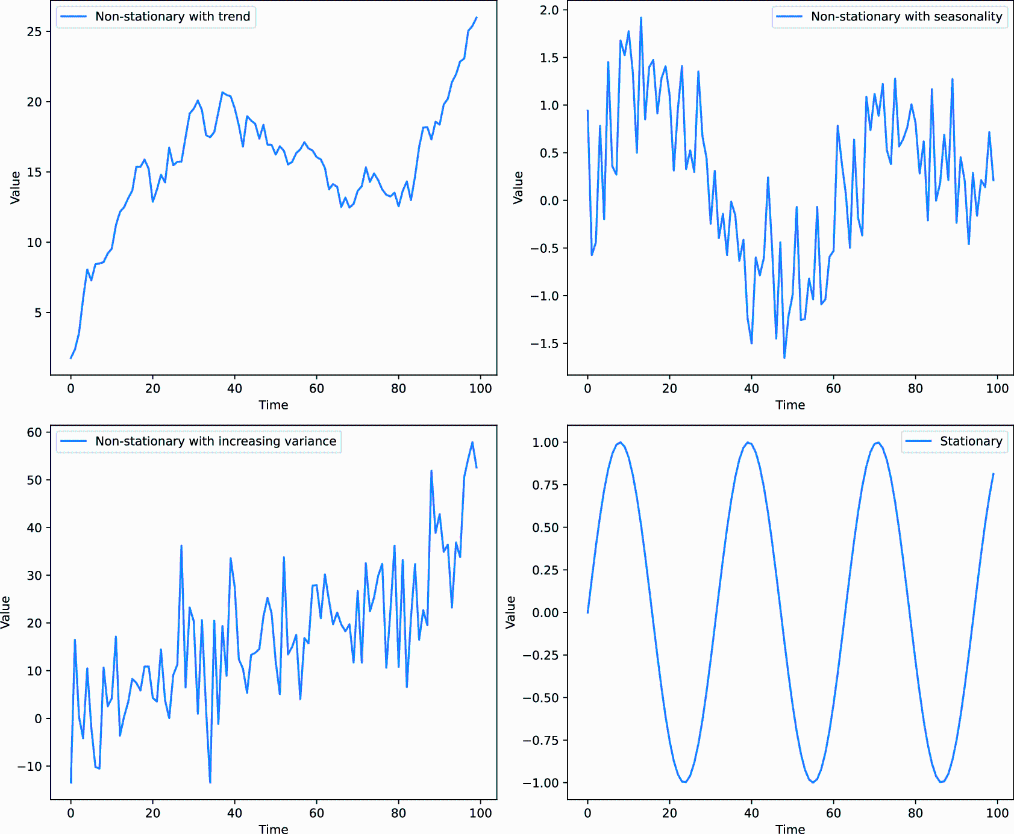
Compare illustrative nonstationary series containing trends or seasonality with a stationary series whose statistical properties remain stable. section 7.3.5



