A triangle is defined by exactly three vertices joined by three edges. Every vertex is a point, but many other points can lie on or inside the triangle; keeping those terms distinct makes geometry code and documentation clearer. section 2.2.1
Applied geometry relies on a few precise distinctions:
- A point on a triangle belongs to its boundary, while a point in a triangle belongs to its interior; an edge is part of the boundary, not the interior surface. section 2.2.1
- A degenerate triangle has zero area. A needle has coincident points; a cap has three distinct collinear points. section 2.2.2
- Degenerate triangles can damage mesh topology, where topology describes which elements touch which. section 2.2.2
Triangles as surface elements
A triangle mesh represents a surface using only triangles and line-segment edges. In a manifold mesh, an edge has at most two adjacent triangles, and a triangle can have up to three neighbors. More triangles can improve approximation accuracy, but increase model size and affect operation performance and reliability. section 2.2.2 section 11.2.3
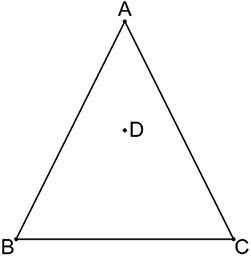
Use the figure to distinguish triangle vertices from the other points contained in or associated with a triangle. section 2.2.1
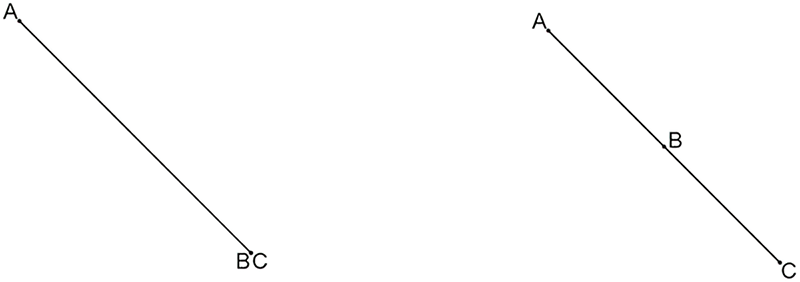
Use the figure to compare the two principal zero-area forms: needles and caps. section 2.2.2

