A neuron is a small computational unit in a neural network. It receives numerical inputs—either raw data or outputs from other neurons—and produces an output that can feed the next neuron. An artificial neuron is a simplified model of a biological neuron; a perceptron is a mathematical model of this unit. section 8.2.2
To produce its output, a perceptron multiplies each input by a weight, combines the weighted inputs, and passes the result through an activation function. Weights determine how strongly inputs contribute; bias terms also play a role in the perceptron. Activation functions provide the nonlinear step. section 8.2.2 section 8.13
Figure 8.3 A neuron gets the inputs, processes them using mathematical functions, and then generates the output.
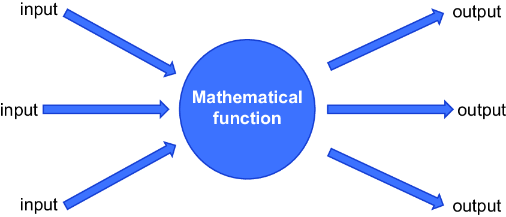
Follow the inputs through the neuron's calculation to its output. section 8.2.2
Neurons are commonly arranged in layers. An input layer receives data, hidden layers process it and learn features, and an output layer makes a prediction. In the layered arrangement shown here, a neuron's inputs come from the preceding layer and its outputs go to the next. section 8.2.3
Recognizing a face
A face-identification network trains on images paired with names. As image data passes through its neurons, hidden layers learn attributes useful for distinguishing faces; the output layer produces the prediction. A convolutional neural network uses a more localized connection pattern: each neuron in a convolutional layer connects to only a small region of the input. section 8.2.1 section 8.2.3 section 8.6.1





