An artificial neuron is a simple nonlinear computing unit. It combines input data with associated weights, a bias, and a threshold or activation function to produce an output. Neurons connect into input, hidden, and output layers, forming adaptive neural networks that approximate relationships such as recognizing objects in vehicle-camera images. section 9.7
A neuron inside a small classifier
A practical network computes a weighted input sum plus bias, applies tanh to hidden-layer values, and passes the resulting activations to an output layer. A penguins classifier uses bill length, bill depth, flipper length, and body mass as inputs, with ten hidden neurons and three output classes. section 9.7
Figure 9.15 Neural network node demonstration
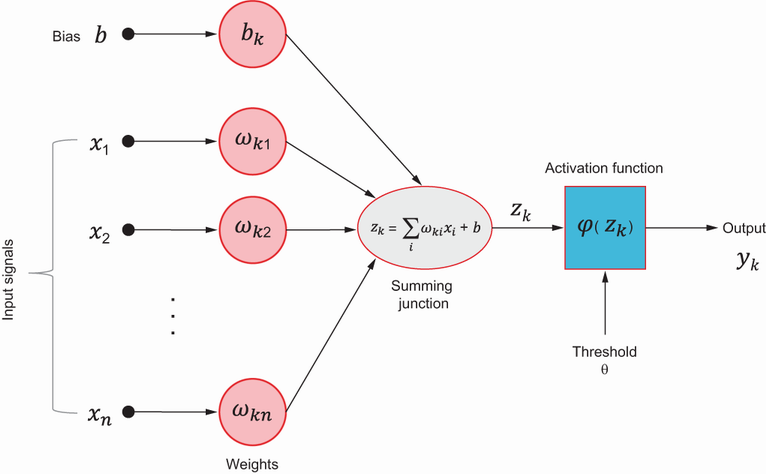
Use the node demonstration to inspect how inputs, weights, bias, threshold, and output fit together. section 9.7





