An artificial neuron is a small computational unit that transforms numerical inputs into an output. Inspired by biological neurons, it is a deliberate mathematical abstraction, not a miniature biological cell. Its importance lies in how many such units work together in a neural network. section 3.1.1 section 5.2.1
A neuron’s computation has several parts:
- Inputs represent features as numerical values. Each input is multiplied by an adjustable weight, which scales its contribution. section 3.1.1
- The weighted inputs are added together with a bias, an adjustable constant that shifts the combined signal. section 3.1.1
- An activation function transforms the combined signal into the neuron’s output. Nonlinear activation lets networks model patterns that weighted sums alone cannot capture. section 3.1.1
Figure 3.1 Structure of an artificial neuron. Each input is scaled by a weight, summed with a bias, and passed through an activation function. This simple pipeline is the basic computational unit from which neural networks are built.
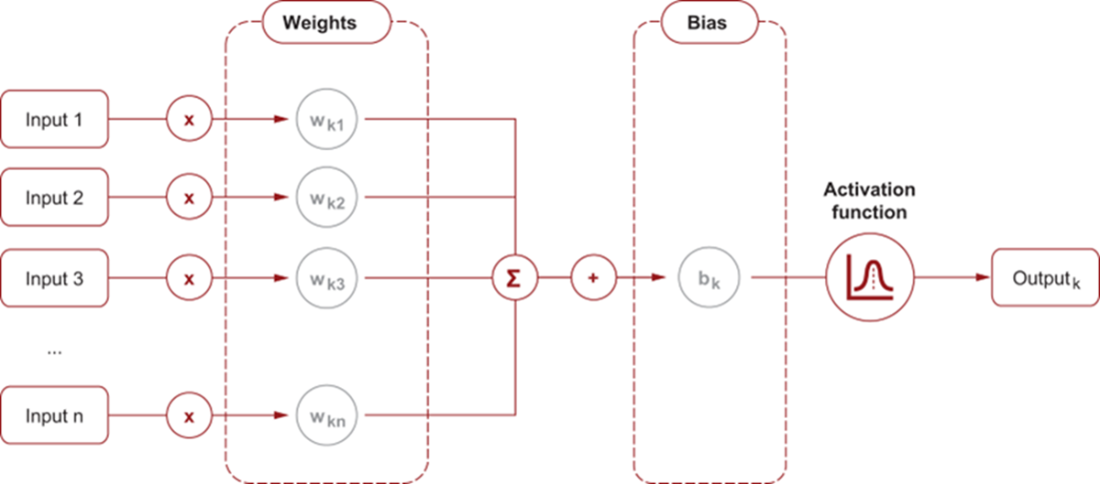
The diagram traces inputs through weights, summation, bias, and activation to the output. section 3.1.1
A single neuron performs a modest transformation. In a layer, many neurons process signals in parallel; connected layers reshape those signals step by step. Hidden layers can build intermediate features, allowing a deep network to represent more complex patterns than an isolated unit. section 3.1.2 section 3.6
Classifying email
A network might receive email features such as word frequencies or metadata and produce probabilities for categories such as personal, work-related, or spam. Neurons in hidden layers transform the inputs through learned connections before the output layer produces its prediction. section 3.1.2
Training adjusts parameters such as weights and biases; the learned weights act as a distributed memory across the network. Backpropagation identifies how weights contribute to error, and an optimizer adjusts parameters to improve performance. In early and widely used formulations, individual neurons respond to current inputs and fixed parameters rather than maintaining their own explicit history; later architectures reintroduce forms of memory. section 3.1.1 section 3.6 section 5.2.2
The biological analogy has limits. Artificial neurons simplify connection strengths and temporal dynamics while omitting biochemical processes and cellular structure. Their shared name does not establish that artificial networks think like humans: similar observable behavior can arise from different underlying mechanisms. section 5.2.1 section 5.0









