A neuron transforms values received from the preceding layer. For inputs xᵢ, it computes a weighted sum, adds a bias, and applies an activation function: z = Σᵢ wᵢxᵢ + b; a = φ(z). The weights set each input’s influence, the bias shifts the response, and the activation introduces nonlinearity. section 11.2.1
Each neuron has its own weights, so neurons in the same layer can respond to different patterns. Its output becomes part of the next layer’s representation; during training, gradients guide adjustments to its weights and bias. section 11.2.1 section 11.2
Figure 11.1 A simplified feedforward neural network containing an input layer, two hidden layers, and an output layer. Information moves forward through weighted connections to produce a prediction. During training, error information moves backward so that the weights and biases can be adjusted. Modern deep networks typically contain many hidden layers and many nodes within each layer, producing millions or even billions of adjustable parameters. Despite that scale, they follow the same basic forward-and-backward process shown here.
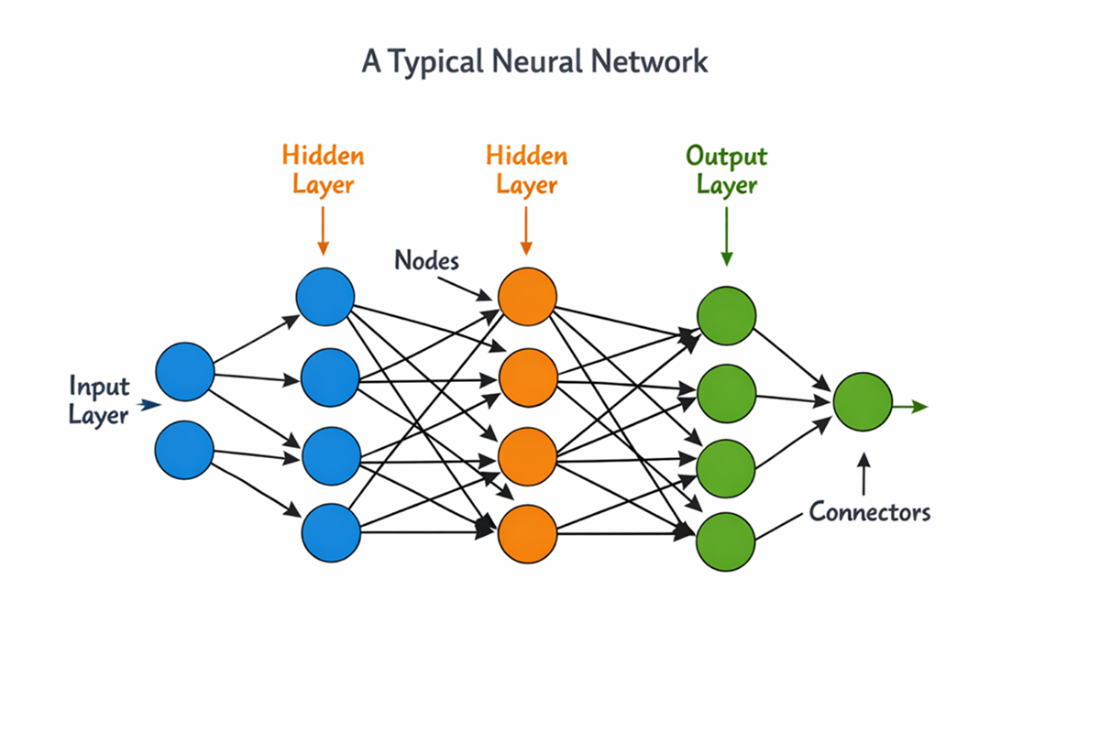
The diagram situates individual nodes within connected layers and shows how their computations contribute to a prediction. section 11.2