A universally unique identifier, commonly called a GUID, provides a practical way to generate distinct values when names, timestamps, or device identifiers can collide. A GUID contains 32 hexadecimal values divided into five groups, yielding 2^128 possible combinations. section 5.6
Use a GUID when coordinating output from multiple systems:
- Append the system name and a randomly generated GUID to an output filename. section 5.6
- Generate the value with the PowerShell New-Guid cmdlet rather than relying only on timestamps, system names, or device SIDs. section 5.6
- Use the resulting name when several remote agents write results to a shared network location. section 5.6
Protecting remote collection output
A script collecting Visual Studio Code extension data from multiple computers can write each result to a central network share using the computer name plus a randomly generated GUID. This avoids overwrites even when machines share names or execute simultaneously. section 5.6
Figure 5.10 Example workflow for collecting data returned by remote agent executions to a central location
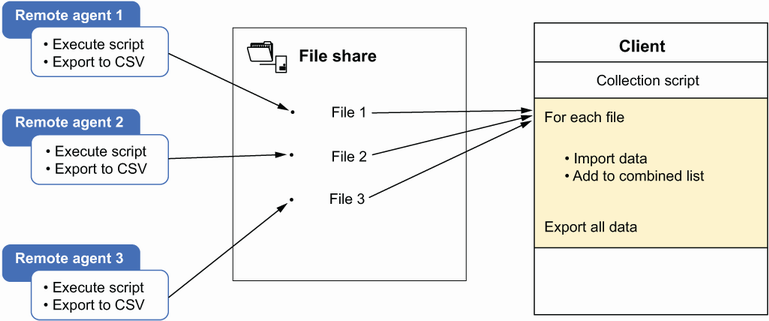
Shows the workflow for collecting results from remote agent executions in a central location. section 5.6









