A shopper searches for a product, opens a result, and buys it. Each observable action is behavioral data. In search systems, recorded actions are called signals: they show how people interact with queries, results, and content, rather than what the content says about itself. section 1.3.2 section 4.1.1
A practical signal pipeline has four parts:
- Capture searches and the results shown, followed by clicks and context-specific actions such as purchases, likes, facet clicks, or dwell time. section 1.3.3 section 4.2.1
- Store enough context to connect actions to searches. Query logs can record a user identifier, query, and timestamp, allowing searches to be ordered and grouped. section 6.3
- Aggregate patterns across users, then use them to improve future query interpretation or ranking. Repeated behavior is more informative than one person’s search. section 4.2.1 section 6.3
- Check what the signals can actually support: a click does not reveal why someone clicked, and higher-ranked results tend to attract clicks regardless of relevance. section 11.0 section 11.1.1
From clicks to a query-specific boost
Suppose an illustrative event table has query_text, doc_id, and action columns. `SELECT query_text, doc_id, COUNT(*) AS clicks FROM signals WHERE action = 'click' GROUP BY query_text, doc_id` identifies frequently clicked query–document pairs. Such counts can suggest candidates for signals boosting, not prove that each clicked document is relevant. Keep the displayed results and later actions available when assessing the pattern. section 4.0 section 4.2.1 section 11.0
Behavioral data supports several distinct decisions. Signals boosting raises popular results for frequent queries; collaborative filtering learns preferences from interaction patterns; and learning to rank can use click-derived judgments to train a more general ranking function. Query sequences can also reveal related phrases, misspellings, and refinements when short queries lack context. These approaches complement document content rather than replace it. Personalization needs restraint: past activity should not override a user’s explicit query. section 1.3.3 section 6.3 section 9.0
Figure 4.2 The reflected intelligence process. A user issues a query, sees results, and takes a set of actions. Those actions (signals) are then processed to create learned relevance models that improve future searches.
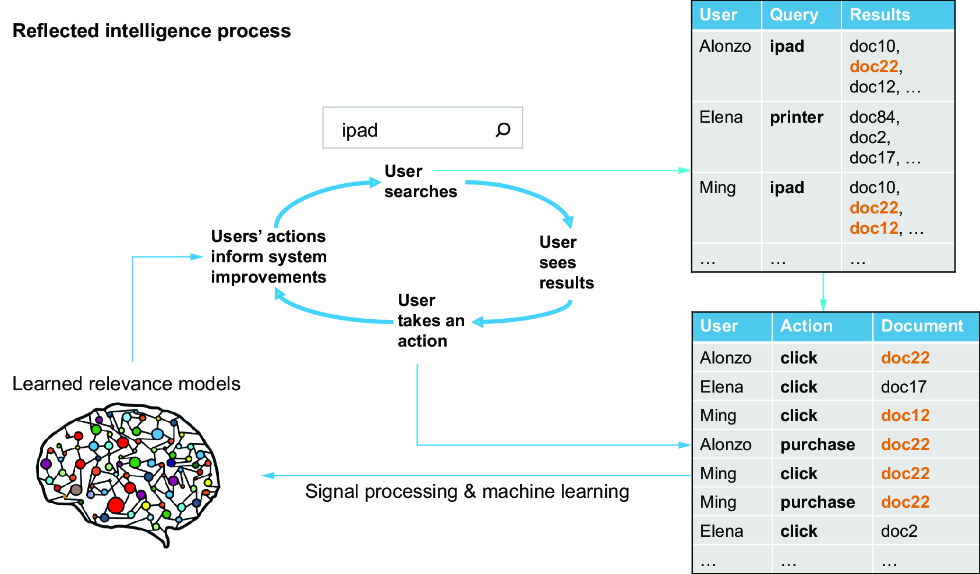
Follow a search from displayed results through click and purchase signals to a learned relevance model deployed for later searches. section 4.2.1




