Behavioral data records what users actually do—such as listening, skipping, liking, or adding tracks to playlists—rather than what they say they want. Comparing these signals with customer feedback can reveal gaps between intended and actual behavior. section 2.1.2 section 2.2.1
Behavioral data supports practical product decisions by helping teams:
- Test whether customers’ stated goals match their real usage patterns. section 2.1.2
- Assess whether an AI opportunity has sufficient, structured data for training. section 2.2.1
- Improve recommendation systems as additional real-time behavior becomes available. section 2.2.1
- Identify limitations such as weak performance for users with little or no prior activity. section 2.2.1
Music discovery
A music platform has years of structured listening habits, track skips, likes, and playlist additions. That behavioral dataset makes a recommendation engine more feasible than adaptive playlists or voice search, which require unavailable data sources. section 2.2.1
Language-learning usage
Potential users may say they want to learn daily, while usage shows they open the app only once or twice on weekends. The discrepancy points toward product changes that support the desired habit. section 2.1.2
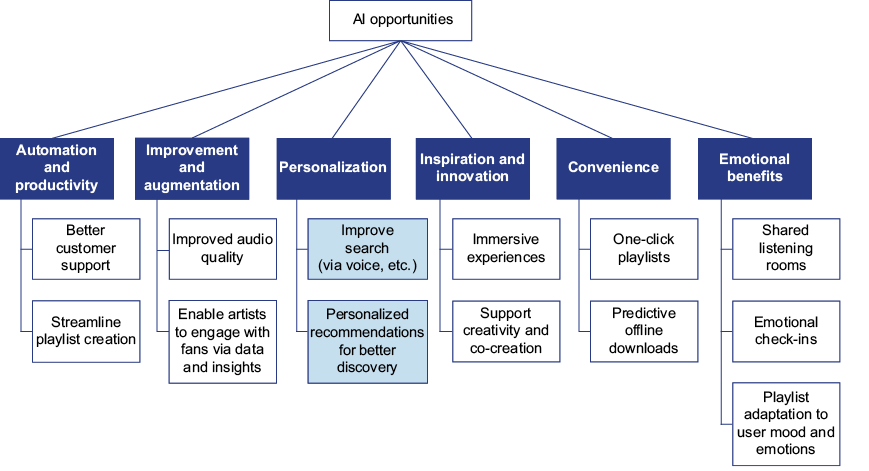
Use the opportunity tree to locate behavioral data within the personalization branch and connect evidence to prioritization decisions. section 2.2.1




